Sunday, August 19, 2012

Romantic Love Between Blacks & Latinos

When I met Gwen, a fair-skinned Puerto Rican woman of mixed racial ancestry at the church I used to attend, there was a strong mutual attraction. The first time I asked her out, she cheerfully and excitedly gave me her phone number. When I called, her passionate response was, name the time, name the date! And it was on—so I thought! 

After our date, Gwen became very distant refusing to go out with me again saying that it was only an attraction; nothing more. Yet, other church members and I consistently caught her watching me intently from a distance. She even acted somewhat hostile toward another woman whom I started seeing. Word got around the church that Gwen's mother did not want her getting involved with black men; only whites and non-black Latinos; preferably a fellow Puerto Rican.

I've heard of other cases where Latino parents threatened to disown their daughters if they were to marry a black man. As disgusting as this sounds, it seems to be only a minor example of Latin American racism, which so many Latinos I have met deny exists.

R1-17A


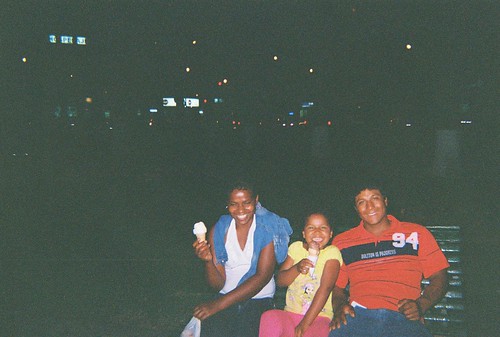
Happy marriages between Blacks and Browns, such as the Ormeño family (above) in Perú are much more common and accepted in Latin-American countries than here in the USA.
 
While growing up in New York City where there were a lot of social interactions, cultural exchanges, and political alliances between African-American and Puerto Rican communities, I knew of African-American boys and girls dating Puerto Ricans. I wonder; however, how many of those Puerto Rican boys and girls took their African-American girlfriends and boyfriends home to meet their families over dinner.

In the book Boricua: Anthologies of Puerto Rican Writings, it was pointed out that many Puerto Rican parents told their sons and daughters not to bring blacks home. I'm not sure if that included black Latinos or just African-Americans.

I do know that a lot of black Latino families, not all, encourage their children to improve the race, as they call it, by marrying someone lighter or white so their children will experience less racism. From my personal interactions with Latin-American women, here and in Latin-American countries, it is usually the fair skinned ones, like Gwen and the white ones who seem to take more of an open interest in me. The black ones, as a rule, didn't seem to take me too seriously, with the exception of a couple who wanted what was in my pants [wallet] because I'm a gringo.


Through my own travels to various Latin-American countries, I've observed a lot of interracial dating, marriages, and mixed children through marriage as well as wedlock. However, from my own observation, the interracial relationships are primarily among those in the lower portions of the economic ladder being that “class” is a bigger issue in Spanish-speaking countries than race. 

It was brought to my attention that many non-black, upper class Latin Americans discourage their children from from getting involved with blacks in their own countries, although some do as was alluded to in the first chapter of Laura Esquivel's best-selling novel, Como Agua Para Chocolate (Like Water for Chocolate), when the father died of a heart attack upon learning that his daughter had a baby by a black Mexican man...

Thursday, August 16, 2012

Volunteer Work While Traveling?


VOLUN-TOURISM
Would you “pay a fee to do volunteer work 
in a foreign country while on vacation? 
Why? 

A community center in the predominately Black district of El Carmen in Chincha, Perú where I can volunteer free of charge... makes perfect sense!
I used to seek out volunteer work in Spanish-speaking countries I planned on visiting because I figured that it would help improve my Spanish and be culturally immersed, but was appalled to learn that these agencies are charging $100 to $1400 to work for “free.” One year, while planning my vacation to Ecuador, I contacted an agency asking about the logic of paying them to volunteer your time to help with a worthy cause. This person responded with an arrogant tone explaining his logic, and to this day, it still does not make any sense. And with his attitude transmitted in the tone of his e-mail, I would have thought twice about paying him a dime, if anything at all, even if I were willing to pay a fee. You would think that these people would be happy to have someone work for free vs spending their money enjoying their vacations.
I'm having trouble believing that people are actually paying these fees, but they are out there. I've spoken to them in forums, such as couchsurfing.com and on other travel sites. They too could not give me a logical explanation for their motive when they could be spending their hard-earned dollars on enjoyment and souvenirs.  Would YOU do it, and why?   I heard the argument that these fees help with operational costs, however, seeking donations and seeking volunteers are two different things.
I brought this up in a forum and one comment that stood out for me was, in my humble opinion I can make more of a difference walking into a school, orphanage, community organization that needs help that day/week and just get it done! I am in total agreement, for example, there is a black community in Southern Perú that I know very well who can use my skills in tutoring children in English and developing their literacy and math skills. Upon my return to Perú, I will definitely volunteer my time, and even buy refreshments for the kids and staff. These people will not even think of being unethical enough to charge me a fee.

Some well-traveled acquaintances of mine agreed on the fact that "volun-tourism (volunteer tourism)" is one of the most notable, lucrative, and corrupt hustles. Often times the money does not go the project or the people it is supposed to be serving. Sadly, this is the case in many "underdeveloped" countries.


Monday, August 13, 2012

Why I Chose a Spanish-Speaking Godchild

When I made my first trip to Perú, my only interests were improving my Spanish and being exposed to Afro-Peruvian culture. I stayed with a reknown Black family, right in the hub of Afro-Peruvian culture--the District of El Carmen, in Chincha, Perú.

I brought a lot of small gifts and candy to distribute to those with whom I established rapport, including the children. I have no idea why, but my heart went out to three-year-old Daniela who was struggling to remove the wrapper from the candy I gave her. As I went over to help her, I felt a strong, inexplicable feeling of kinship and attachment. And obviously, the feeling was mutual because she asked me over the phone after my return to the USA if she could be my daughter. Her mother, who was standing by and seemingly feeling embarrassed, took her off the phone, and instructed Daniela to say cuidate (take care), and hung up.

When I returned to Perú, her mother, Karina, was happy that my return made Daniela very, very happy. Karina asked me if I had any children, I said only Daniela, and Daniela just looked at me with extreme delight. She and I have a father-daughter relationship. When I'm in Perú, I take her, her cousin, sister, and friends to the beach, play centers, and to dinners and ice cream parlors. I taught Daniela to play the Spanish version of Scrabble and Monopoly, and chess.

Her older sister, Ruth (17), is our chaperone ;-)  ...just making sure that I'm not one of those... “pedophiles.” Of course, she knows better than that but it's better to be safe. I too felt safe because I didn't have to worry about being accused or suspected of anything. When I'm not in Perú, I call Ruth and Daniela to say hello and wire money. I don't know anything about Daniela's real father, other than some gossip I heard about his being a ladies man or a mac-daddy.

Unfortunately, I learned the hard way that I have to be careful about the gifts that I buy for Daniela because members of her family will take it and sell it. I was flabbergasted and irked six months or so after I left Perú to learn that the brand new bicycle I bought for Daniela was sold by an adult member of her family. Now, I feel that the best I can do is just show Daniela the love I have for her with my time. As of this writing, she is approaching her 10th birthday. I told her that upon my return that I want to teach her pre-algebra and some English.

I'm very happy and honored to be that male figure to fill the void that Daniela needs in her life. I love her as though she were my own daughter, and I often tell her yo te amo, mija (my daughter, I love you).


Friday, August 10, 2012

I Will Miss Jairo Varela of Grupo Niche

Jairo Varela, Leader of Colombian salsa band
GRUPO NICHE
December 9, 1949-August 10, 2012

It was by accident as I was browsing the profile of a Facebook friend on my Spanish-speaking Facebook account when she had a background photo of Jairo Varela, with the words, 1949-2012. I've never felt such  intense grief for someone I never met personally. Jairo and his band Grupo Niche brought so much joy to my life with his music over the years. Long before the Internet, I used to buy his albums without hearing musical tracks and was never disappointed. It's one thing to enjoy the music, but being able to “feel” his music took my enjoyment to another level. I don't think Grupo Niche will be the same without Jairo Varela. rest in peace, my brother!

Don't Use Vayama for Cheap Travel!

The most common words on Yelp.com regarding Vayama are “Beware” and “Caution,” along with some profanity. 

In November of 2010, I made reservations for flights to Lima, Cartagena, Quito, and back to San Francisco. Vayama sold me the reservation, but left off my return flight back to San Francisco. When I called Customer Service, I was told that I would have to make another reservation because I did not catch the so-called error in time. Thus, to avoid being stranded in Quito, Ecuador, I had to resort to Travelocity to find a cheap fare back home.

Once I got back from my South American trip, I went to tripadvisor.com to warn others about Vayama, and found that there were many others complaining about this travel service. Eventually, the Vayama forum monitors on tripadvisor.com began deleting all posts  complaining about Vayama. They have people there who defend Vayana and claim those who are getting dirty deals are simply inexperienced travelers. Why aren't other on-line travel sites getting these levels of complaints as Vayama?

On Yelp.com, Vayama is averaging one and one-half stars. That's because only two or three people gave it more than three stars. One person upgraded it from one to two stars when Vayama made a settlement. Everyone else gave it one star to date. The most common words on Yelp regarding Vayama are“Beware” and “Caution,” along with some profanity.


Wednesday, August 8, 2012

Colombia's Black Slave Liberator

Benkos Biohó also known as Domingo Biohó, ancestor of the late Afro-Colombian singer, composer and drummer, Paulino Salgado Valdez, was the leader of runaway slaves Colombia during the 17th century. Said to have been born in what is now known as Guinea Bissau of Western Africa in the late 15th century, Biohó was captured by a Portuguese slave trader and sold to a Spanish businessman, then sold again to another Spaniard in 1596 in Cartagena, Colombia.

Biohó, a former African king,  escaped from the slave port of Cartagena with ten others  by boat and founded San Basilio de Palenque, the legendary village of rebel, runaways slaves in 1713. He organized a strong army pf more runaway slaves and formed an intelligence network that, eventually, the King of Spain gave up sending troops on what turned out to be useless attacks their heavily fortified mountain hideaway of rebel slaves, and San Basilio de Palenque earned their freedom from the Spanish more than 200 years before the rest of Colombia.

However, in 1619, while walking carelessly, Bioho was caught by the Spanish forces and hanged on March 16, 1621. By the end of the seventeenth century in the area of San Basilio de Palenque had over 600 black rebels, under the command of Domingo Padilla, who claimed for himself the title of captain while his wife Jane adopted that of viceroy..

Sunday, August 5, 2012

Visiting the Center-of-the-World; the Equator (Ecuador)

R1-20A

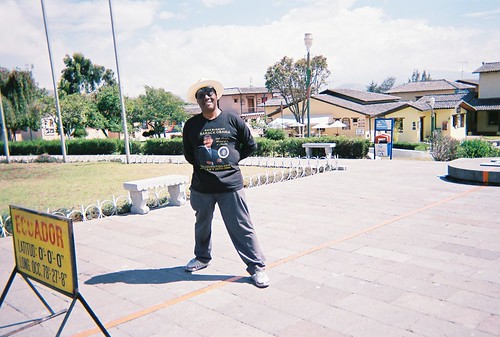
Standing on the equator, which is English for 'Ecuador,'  with one foot in the Northern Hemisphere and the other foot in the Southern.

As a rule, when I travel, I avoid the tourist areas and as much as possible try to mingle with every common people of the country that I'm visiting; especially in a Latin American country. This is for the purpose of being totally immersed in the Spanish language and the cultures. And as Juan, a friend from Venezuela told me, the barrio (the hood) is where the real culture is. I believe it! However, when I visited Ecuador, I could not resist wanting to have my picture taken with one foot in the Northern Hemisphere and the other in the Southern.

Gloria, whom I met through a friend on Facebook became my friend and guide. We caught a bus in downtown Quito for a 40-minute ride to La Mitad del Mundo (the Center of the World), a major tourist attraction with restaurants, a planetarium,  a monument museum celebrating Ecuador's cultural diversity, including Afro-Ecuadorian, and plenty of shops selling souvenirs competing for tourist business. On weekends, there is a musical entertainment

Being that the equator runs through the Andes Mountains, it was not very hot. In fact, I was very comfortable wearing a long-sleeve shirt. It was so windy that my brand new panama hat I just purchased was blown off my head more than once.

.