Showing posts with label Stereotypes. Show all posts

Friday, June 12, 2015

Determining One's Ethnicity

 
 A statue of Pedro (Primero Negro) Camejo, a high-ranking officer in Simón Bolívar's army in Venezuela's liberation from Spain.
 
Today, I went to a Mexican restaurant for lunch. The customer in front of me, an olive-skinned woman, ordered in Spanish and the cashier responded likewise. When my turn came, I ordered in Spanish and the cashier responded in broken Spanish and English. After responding this way for the third time, I pointed to my Caracas, Venezuela baseball jersey I was wearing and told her in Spanish that in Caracas people speak Spanish as well. Suddenly, thinking that I'm from Venezuela, her Spanish became fluent.


No, I am not from Venezuela, and I never told her that I am from Venezuela. I bought that baseball jersey when I was visiting Caracas, and simply stated that Venezuelan people speak Spanish as well, not just Mexicans—that was the point that I was trying to make. I wanted to teach little miss smarty pants a lesson that you cannot “LOOK” at people and determine their ethnicity.  

Yes, I'm African American, but as far as she, a total stranger is concerned, I could have been an Afro-Spaniard, Afro-Nicaraguan, or even an Afro-Mexican. An Afro-Colombian recently wrote on my blog stating how frustrating it is that in Miami, of all places with a large Afro-Latino population, people still assume that because he is black that he cannot speak Spanish.

The same thing applies to my fellow African Americans. One evening in Richmond, Calfornia, I gave an African-American woman, whom I met for the first time, a ride in my car. She noticed my New York accent and asked me if I am African. Confused, I answered no. She then asked me if I am a “regular black”. Now, what is a “regular” black, considering there are black people all over the world?

  A few African Americans who hear me speak Spanish would look directly at me and ask me if I am black. Of course, I am, what else could I be? Still, others ask me to confirm that I'm African American and not a member of another black ethnic group. Now, that I take as a compliment because it speaks to my global mindset.

Tuesday, April 16, 2013

So, I'm a Sellout--A Wannabe Latino?


When Donna, a woman I was dating, telephoned my home for the first time, she heard my answering machine's outgoing message in English and Spanish with some salsa music in the background. In my mind, I was just trying to be unique and cutesy like so many others with answering machines. 

Donna later told me that my outgoing message gave her the impression that I was trying to get away from being Black. I was somewhat flabbergasted, considering my experience with the Black Student Alliance in school, and my love for the Black theater, music, art, literature, and history.

However, I'm also a big fan of the opera and the symphony, which I attend every chance I get. During my junior high school years, I aspired to play with the New York Philharmonic Orchestra as a classical clarinetist, and got accepted into what is now known as the La Guardia School of the Performing Arts in New York's Lincoln Center. 

So, it's not that I'm trying to get away from being Black, I'm just an individual with diverse taste and interests. 

When I decided to adopt Spanish as my second language due to my love for Latin music, and due to my direct childhood connection with the Puerto Rican community, I was encouraged to dig deeper and learn more about Latin American culture as well. This provoked Donna into sarcastically reminding me that nothing has changed; I'm still “Black!” .

Donna's articulated judgment of me was not new. I've been hearing similar comments from other African-Americans and some Latinos; calling me a sellout and a wannabe Latino. 

An African-American co-worker who overheard me in a Spanish-speaking conversation asked, “you wish you were Mexican, don't you? 

A Dominican-American woman apparently annoyed and disgusted by my extensive knowledge and love for Latin music once challenged me to name some “Black” artists that I like, which gave me a good laugh because along with the artists that I mentioned to her; McCoy Tyner (jazz pianist), Pattie Labelle (R&B singer), and Michael Morgan (conductor of the Oakland Symphony), I also named some “Black” artists from her home country, the Dominican Republic such as Cuco Valoy (salsa), Johnny Ventura (merengue), and Anthony Santos (bachata), LOL!

What Donna, and my other critics cannot seem to grasp is that I'm an African diaspora enthusiast. As a high school teen, I only lived one block from the Schomburg Center for Research and Black Culture in Harlem, NY. This library/museum named after a Black Puerto Rican, carries over 6,000,000 items covering Black people from all over the world. 

I put a lot of emphasis on the Afro-Latino cultures because of my desire to perfect my Spanish. When traveling, I generally seek out Black communities in the countries that I visit. Today, I can hold intelligent conversations with most Latin-Americans about their home countries as I myself continue to listen and learn about the culture.

Thursday, April 4, 2013

Bashing Black Stereotypes ... "in Spanish”


I was riding a San Francisco Municipal bus into the heavily populated Latino area known as the Mission District to check out a Peruvian restaurant that was highly recommended by a Peruvian acquaintance. A Black guy boarded and sat next to me, and I assumed that he was African-American until he asked me a question in Spanish. I said to him that his accent sounds Cuban, and he joyfully affirmed that he is indeed Cuban. 

Because I had an unforgettable time in Cuba myself, this made a great conversation piece between us until I reached my stop. I then started noticing others on the bus, mostly Latino, looking curiously at us; two black guys conversing effortlessly in Spanish. This is far from the first time that I’ve observed such reactions as some even appeared entertained by such a perceived spectacle.

It never ceases to amaze me how so many Latinos could be so oblivious to the racial diversity in their own Latin-American communities, which not only consist of black folks, but whites, Asians, and Jews. When I was in Venezuela, I shopped at a meat market owned and operated by Middle Easterners. Although, Latinos should really know better, the Spanish-language media contributes greatly to such lack of awareness.

I get similar reactions from African Americans. I was at a doctor's appointment when I found myself interpreting for a Spanish-speaking patient. Later, a nursing assistant approached me marveling at my Spanish. Annoyed,  I said to her, “you seem surprised” as I was ready to let her have it with a lecture on Latin America's black history, but she denied being surprised.

One day after work, I was riding a commuter train with an Afro-Cuban and an Afro-Colombian. Because the Afro-Colombian could not speak much English, we kept our conversation in Spanish and was amused noticing blacks, whites, and brown-skinned Latinos appearing  astonished hearing three "brothas" conversing in Spanish. I'm thinking that this should help wake folks up.


There was a Mexican-American woman at work who happens to be one of the few U.S. Latinos aware of the existence of black Spanish speakers as she assumed that I was one because she observed me speaking Spanish to members of the public. 

When I shared my excitement about my upcoming trip to Perú. She responded, "oh, is that where you are from?" When I told her that I am from New York, she frowned in utter disbelief and brushed me off without bothering to ask how come a black "American" can speak Spanish. I would have told her if she has asked!


I belong to a group on Facebook for blacks who are bilingual; not only in Spanish, but in a host of other languages. The group, as of this writing, is 353 members strong and growing, and are mostly African American. It is so nice to know that there are so many other black Americans around the U.S. who are not limited to speaking the stereotypical English and/or Ebonics. I myself enjoy meeting and greeting people in French, Haitian Creole, Russian, Portuguese, Amharic, Tigrinya, Arabic, and Tagalog (Filipino).


Friday, February 15, 2013

I'm So Glad I Didn't Stereotype Her


I just came out of a job interview, which consisted of a panel of four. One of the interview panelist fits the stereotypical profile of a Latina and has a Spanish first and last name. I already knew that the ability to speak Spanish was a plus, so before I left the interview, I wanted to, as rapper Kid Frost would say, “bust some Spanish” to show off my Spanish-speaking skills, and that Latina woman appeared to be the perfect person with whom to exchange a few words to help me impress the panel. Yes, that's stereotyping, I know, because I've personally met too many Americans of Latin American heritage who speak little or no Spanish.

Finally, a question came up during the interview, which I thought would be a perfect sedge-way for “busting” my Spanish. Without looking directly at this Latina panelist, I asked, does anyone here speak Spanish? I once posted a blog post, What Do Spanish-speakers look like, about how you cannot look at people and determine what language they speak. No one raised their hands; not even the Latina panelist. So, I was so glad that I did single her out because that would have been embarrassing to me and frustrating to her because no one likes being stereotyped.

I went on and answered the question and described how I've traveled to nine Spanish-speaking countries and was totally immersed in the Spanish language, and even talked about how I gave a Venezuelan and a Peruvian feedback on their curriculum vitaes. The smiles of delight were evident on everyone's face, and at the end of the interview, every one of the panelist came over to shake my hand personally as I exited the room.

I left with a good feeling, about the how the whole interview went. However, we never know who we are competing with for an open position., therefore regardless of their decision, I already have a job, and for that  am thankful!

Friday, December 7, 2012

Who's Planting the Racial Seeds?

While waiting at the checkout line in a store one evening, I engaged in a conversation with an El Salvadorean woman, and her child who could not have been more the 6 years old. The little girl asked me, what is a black guy doing speaking Spanish? I can tell by her warm demeanor that she did not mean any harm. In fact, the minute she saw me, she gave me a friendly, but curious gaze. Although, her mother calmly scolded her for making that comment, I high-fived the child wondering who planted the racial seed in her heart. In any event, I would love for this little girl to meet my goddaughter Daniela who is Black and speaks Spanish only!
On another occasion when I used to do recruiting for a federally sponsored job-training program for youth a young Latina came into my office with her mother who did not speak any English. Out of fearful concern for her daughter, she asked me if there were a lot of Blacks in this institution. I just bit my lip to keep from laughing. The mother must have thought I was “different” because we were speaking Spanish (LOL).
Fortunately, her daughter was not concerned and obviously did not buy into the racial prejudice of her mother. She went into the training program and got along well with everyone, regardless of color.


Friday, June 17, 2011

Blacks Stereotyping Blacks

Black Americans Who Are Oblivious
to Black Latinos (Afro-Latinos)

In other parts of this blog, I talked about the ignorance of many Latinos who feel that only brown or olive skinned people can speak Spanish and enjoy Latin music and are totally oblivious to the black Latinos/Afro-Latinos in their own communities. This post is addressing the ignorance of many African-Americans who feel that black people are only limited to English, Ebonics, and hip hop. It's bad enough when Latinos stereotype blacks; it's appalling when blacks stereotype blacks.

When I was working as a security officer in a downtown-Oakland office building, I had to laugh when I learned that my African-American co-workers were clowning me behind my back as they stamped their feet, snapped their fingers in the air making the sound of castanets, and referring to me as Merengue Man. It was hell-a-funny in one sense and hell-a-sad in another.

A question an African-American supervisor asked my co-workers, referring to me was, “does he know he's black?”

My co-workers often heard me speaking Spanish on the job and listening to salsa music while on break. A question an African-American supervisor asked my co-workers, referring to me was, does he know he's black? On another occasion, some African-American youth referred their classmate, a black, Spanish-speaking girl from Panamá, as a confused niggah. That says a lot about their knowledge of black history. More slave ships went to Spanish-speaking countries than those that came to the U.S. Furthermore, when the Spanish conquistadors, like Cortez and Pizzaro, first invaded what we today know of as Latin-America, there were black slaves marching in their ranks. Spain had African slaves more than 100 years before the before the U.S.

What is it about so many black Americans who think we are the only legitimate blacks on the planet?

I always get a thrill and a chuckle when an African-American (and members of other ethnic groups, as well) react in shock when they hear me speaking Spanish. What is it about so many black Americans who think we are the only legitimate blacks on the planet? I've often heard black Americans infer that blacks of other cultures were non-black. In fact, I've been asked myself if I were black. Black people come in many nationalities and cultures, and speak many different languages.

Some African-American youth referred to their classmate, a black, Spanish-speaking girl from Panamá, as a confused niggah.

Yes, I know that I'm black. I'm also proud and knowledgeable of black history; not just in the United States, but around the world. In addition to Latin music, I like R&B, jazz, classical, new age, and world beat. Spanish is my second language, but I also know a tiny bit of Russian, Amharic, Tigrinya, Arabic, and Mandarin, and my skin color will never, ever change because of it.

Friday, May 13, 2011

What Do Spanish-Speakers Look Like?

Nearly 1,400 readers visited this site, and no one has yet been able to give an intelligent answer to my question—what do Spanish speakers look like? Can you? Don't let me grow old waiting!


Former Miss Ecuador - Mónica Chalá

One morning, I stopped in a Walgreens store in San Francisco to buy a Latin-American phone card. The woman at the checkout counter, without bothering to ask if I speak Spanish, suggested that I buy a calling card for English speakers. This is far from the first time someone ASS-umed that I did not speak Spanish. Annoyed, I told her (in Spanish) that I have friends in Latin-America who speak Spanish only and I need this particular card! She acknowledged what I said by mumbling something about San Francisco being a multicultural city. Yeah, whatever!


I pointed this experience out to some friends, and humbly asked for some enlightenment; how do you look at someone and determine what language they can or cannot speak? A former college classmate answered,“ just ignore them Bill. She was just plain stereotyping. I'm sure when you responded in Spanish she felt silly.” 

Another friend, who unlike I, happens to be a black native Spanish-speaker (half Cuban and half Dominican) says she has pity on people like that; she slams them with her Spanish, and the near look of cardiac arrest gives her great satisfaction.

From my growing up near Spanish Harlem in New York City, and working in Latino communities in Oakland and San Francisco, I know plenty of people, white, brown, and black who are of Latin-American ancestry who know little or no Spanish. Yet, I've met people of Chinese, Lebanese, and Jewish ancestries who are “native Spanish-speakers.” The same paradox goes for other languages. 

When are people going to wake up and understand that you cannot simply look at people and discern their first, second, or third language?

Tuesday, April 5, 2011

Mayate


¡Pinche mayate!


A Name They Call Black People

When I saw the film American Me, that was my first time hearing the expression mayate. I was not offended but was extremely curious about the word's origin. All racial slurs have original meanings. I asked a Mexican American friend, and her mitigating response was that it is just a name they call black people. 

However, one summer I was teaching labor market orientation to high school students in Berkeley, California, and approached a group of Mexican-American students with whom I had a fairly decent rapport. I asked them what is a mayate? Obviously containing their laughter and not wanting to hurt my feelings, they became very tight-lipped. What was even more hilarious was that I was pronouncing mayate wrong by putting the accent on the wrong syllable.

Statue of Gaspar Yanga outside of the Mexican town named in his honor who led black runaway slaves in establishing a free Black town by defeating the Spanish over 200 years before Mexico won her independence.

The youngest member of the group repeated the correct pronunciation and told me that it was a little bug. One of the girls in the group shouted, ¡Cállate! (shut-up).  In defiance, he told me that a mayate is a little black bug. Now it was my turn to laugh as my curiosity was finally satisfied. Welcome to the United States of America where almost every ethnic group, including Mexican-Americans, has pejorative terms attached.


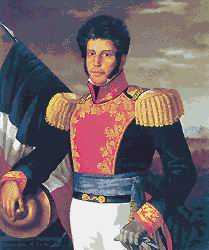
Vicente Guerrero, son of a black woman led Mexico to her independence from Spain in 1810 and became Mexico's second president in 1829. Mexico's state of Guerrero, where the resort city of Acapulco is located, was named in his honor.


Every time I hear that term mayate, it is always used in the context of conflict. In the films American Me and Blood In and Blood Out, mayate was primarily used towards a rival gang known as The Black Guerrilla Family. 

One day, I was passing by a group of Latino construction workers and overheard one venting his frustration on how he felt about “that mayate.” When he saw me looking at him, he immediately stopped talking wondering if I understood. I simply gave him a humored smile and a wink and continued to cross the street at the green light.

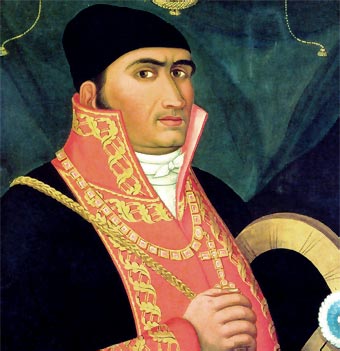
José María Morelos y Pavón, son of a freed African slave, was a revolutionary war hero. Mexico's state of Morelos was named in his honor. 


Because of my level of education, mayate is not something I take personally; it's a joke, actually. It's a joke because even Mexico itself has an African history and presence, particularly in states of Vera Cruz, Oaxaca, and Guerrero, which today still have black villages. 

Mayates, excuse me, Black people, played major roles in Mexico's independence from Spain, including pure Africans like  Juan del Carmen, Juan Bautista, and Francisco Gomez. In fact, according to research done by Jameelah Muhammad that was published in the book, Afro Latino--No Longer Invisible by Minority Rights Press, Africans made important contributions to Mexican folk tales, religion, medicinal practices, cooking styles, and most notably, music and dance.


Related Blog Posts


Sunday, March 20, 2011

English and Spanish and Stereotypes

One afternoon, on an elevator in my office building, I tried to strike up a Spanish-speaking conversation with a gentleman wearing a traditional Mexican outfit. Looking me up and down with contempt, he asked me in perfect English, "what, you're learning Spanish?" After motioning for me to bug off, he stepped onto his floor visibly agitated. I'm thinking, damn , what is "his" problem?

Ever since I was a child, I've always thought it was so cool to speak a second language. Because I lived around so many Puerto Ricans in New York City, Spanish was the most logical choice. However, as I began teaching myself Spanish out of a library book, I became flustered when my Puerto Rican neighbors and schoolmates consistently answered me in English (New York accents).

This frustration followed me all the way into my adulthood. I began thinking; perhaps, Latinos were ashamed of being Latino and simply wanted to assimilate into American society forgetting their language and culture. Finally, I began asking Latinos friends for the real story. Their answers varied. Many do not want to be stereotyped as Spanish-only or illegal immigrants. Others might get a sense that their English is better than my Spanish, thus would find it easier to answer me in English. And there was one response that made the greatest sense of all; if they are learning English, they needed to speak English in order to reach their desired level of fluency.


The big shocker, speaking of stereotypes, is that there are Latinos growing up in the U.S. whose Spanish is limited, and do not feel comfortable speaking Spanish unless they are talking with a monolingual Spanish speaker, preferably a relative. And there those who don't speak Spanish at all.


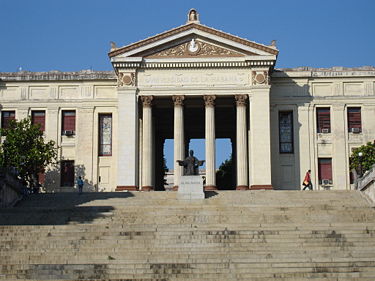
The University of Havana, Cuba, where I took Spanish language intensive training.
For these reasons, I chose to get out more. I mean, out of the country. My first experience of Spanish language immersion out of the country was in Cancún, México where I had a 24-hour layover before my next flight to Havana, Cuba. In Cancún, everyone was pleased that I was speaking Spanish; the people at the airport, the cab drivers, the hotel clerks, and the restaurant workers. By the time I arrived in Cuba, I was warmed up. In Cuba, I was taking a Spanish intensive course at the University of Havana through the Global Exchange organization based in San Francisco. Global Exchange sends Americans to Cuba for various programs such as language, music and dance, and bicycle tours.

One day, a Cuban citizen struck up a conversation with me in English. My mind flashed back to the gentleman on the elevator thinking he may have felt stereotyped and wanted to put me in my place. Well, I began to feel the same sense of indignation with this Cuban stranger assuming I’m an English-only gringo. I was gritting my teeth, saying to myself that I’m going to teach his young, narrow ass a lesson. For everything he says in English, I will respond in Spanish. Now, I’m getting a taste of my own medicine; how Latinos in the U.S. may feel when I speak to them in Spanish versus English.

As I kept answering in Spanish, he finally declared his frustration and demanded that I let him practice his English. Again, my mind went back to all the Latinos in the U.S. with whom I tried to practice my Spanish. I don’t know if I would have demanded that they'd let me practice for that is not my personality, but asking their permission and explaining why would have been a much better approach.