Sunday, September 4, 2011

So Few Latinos of Color on Spanish TV


Many Latinos  tell me that they are all one regardless of color. You would never know it from watching Spanish TV. 

When I first made up my mind to develop my Spanish as a second language, I knew I had my work cut out for me, especially if I was going to teach myself in lieu of formal classroom training. I did pretty good over the years, considering I've had jobs demanding the use of Spanish, and even received bilingual pay. One of the methods I used in teaching myself Spanish was television, mainly Univisión and Telemundo. I used to spend 30 minutes to an hour daily watching telenovelas and their advertisements.

What I found very disappointing was the fact that all of the actors, newscasters, and performers are white, and there was a blatant absence of darker-skinned Latinos, especially black Latinos. Spanish TV, to me, does not reflect the real world of Latinos that I've seen from my Latin-American travels and from living in living in New York and California.

A black Cuban confirmed what was on my conscience. He does not watch Spanish TV because they exclude blacks..

From my personal exposure to the Latino community, I've met people of European, indigenous, African, Asian, and Middle Eastern ancestry, not to mention many of those who are of mixed races. The best Chinese food I ever had was in Lima, Perú. If I didn't speak Spanish (or Cantonese), I would have not been fed.

I casually brought up my newly found hobby of Spanish television to a black Cuban friend of mine who bluntly confirmed what my conscience has been telling me for months—racial discrimination. Thus, he does not watch Spanish TV. That's when I myself stopped watching Spanish television and started watching Spanish videos with some black representation.

Spanish TV does not reflect the real world of Latin Americans that I've seen from my travels, and from living in New York and California.

As of this writing, it dawned on me to ask some Afro-Latinos if they watch Spanish-TV. And if they do, has anything changed in terms of racial diversity. The responses I received were a bunch of expletives, especially against Univisión and Telemundo. One person did acknowledge that Univision has a one black newscaster, an Afro-Colombian named Ilia Calderon.

You who are reading this blog post, and are fans of Spanish-TV, how do you justify such discrimination? I've been told by many Latinos that they are all one, regardless of color. You would never know it from watching Spanish TV. If it's anything other than racism within the Latino community, I'm open to reading your comments in the section below.

Friday, September 2, 2011

Look Who's Teaching Me Spanish

Untitled-3
At the dinner table with my goddaughter Daniela (left, in pink) with some family members in Chincha, Perú.

One of the reasons I was hired on my current job is because of my ability to speak Spanish. I've been teaching myself for a number years without the aid of schools or CDs like Rosetta Stone. That is with few exceptions like the University of Havana in Cuba and El Sol-Escuela de Español in Perú where I took classes and private instructions while on vacation under non-English-speaking instructors.

R1-20A
Local teens at a popular mom and pop hangout in El Carmen, Perú 


As I'm constantly working to improve my Spanish, I find that the children are more patient in their interactions with with me, and in exchange, I give them fun treats like ice cream, candies, dinners, trips to amusement parks and the beach.

R1-10A
Yomira, cousin of my my goddaughter Daniela

In Perú's District of El Carmen, I interacted with local teens, playing scrabble in Spanish and buying them ice cream and sodas. There were times I had to put my foot down because people, including children, think because I'm from the USA, I can afford to buy up the whole store for them. However, upon my return, I plan on spending more time with them. I'm going to be straight up this time and let them know that I'm trying to improve my Spanish and ask them to help me out. In this quiet community, they find me to be a fresh new experience as well.

Wednesday, August 24, 2011

AFRICANDO ALL STARS

Bringing Salsa Music Back to Its African Roots


Featuring Great Voices
of Africa


The very first time, I logged onto the Internet in January of 1996. I had to choose a screen name for my brand new Internet account. Being that I was a diehard salsa dancer and salsa music lover who recognized its African roots, I chose the name Africando, not knowing that they would be as big and famous around the world as they are today. I was first introduced to this African salsa group by a DJ at a local night club. As I was looking over their CD's liner notes, I saw their mission statement, which read, our mission is to bring salsa music back to its African roots.


 “Africando,” mixes “Africa” and the Senegalese-Wolof phrase “ando,” meaning "advancing together."


 Africando, under the musical direction of the Cuban trained maestro Boncana Maïga, of Mali, West Africa, and Ibrahim Sylla from the Ivory Coast, was formed in 1990 as an intercultural merger between Senegalese vocalist and the most prominent salsa musicians from the salsa capital New York City. “Africando,” which mixes “Africa” and the Senegalese Wolof phrase “ando,” meaning "advancing together." As musicians from other African countries were later included, the name changed to Africando All Stars, as they feature some of the greatest voices on the African continent.


An intercultural merger between Senegalese vocalist and prominent salsa musicians from New York City.


Latin music has been very popular in Central and West African countries since the 1940s as Africando set out to connect the musical dots between the African continent and Cuba to the delight of music and dance lovers of the throughout the continent of Africa singing Latin-merican classics in their native tongue Wolof and Spanish, and progressing into singing popular African popular classics with a Latin-American beat. sung in a mixture of Spanish and the Senegalese language of Wolof. The Senegalese musicians call it Wolof-spañol.

Wednesday, August 17, 2011

Deadly Destruction in Latino and African-American Communities


How many more innocent children, men, and women must die senselessly before members of our communities wake up saying enough is enough?


What African-Americans and Latinos Have In Common
Despite the cultural differences, and in many cases, animosity between African-American and Latino communities, we have quite a bit in common. It's bad enough that both communities suffer prejudice, bigotry, police abuse, and discrimination from outside of our communities, but are also plagued by destructive and deadly elements from within our communities with gang violence, and other crimes. Yet, the minute a white person, such as a police officer, harms someone in the African-American or Latino community, there is an uproar from the citizens. When Latinos and African-American miscreants harm decent citizens of their own respective communities, people whine and mumble about how unsafe the streets are. No one wants to speak out and stand up against these terrorists.

There Is Strength in Numbers
Latino and African-American prison gangs are in frequent conflict with each other, but ironically, most are locked up primarily for the harm they did to members of their own ethnic groups. During the 1960s, the Black Panthers (African-Americans), the Brown Berets (Mexicans), and the Young Lords (Puerto Ricans) were standing up in unison against an oppressive American system. Isn't about time that we all stand up to an oppressive, criminal element in our own communities. There is strength in numbers!

Latin Music: Bolivia


Afro-Bolivian, Black Bolivian
Africa in Bolivian Music
  
When people talk about Latin music, they are generally talking about salsa, Afro-Cuban, merengue and other forms of music from the Latin tropics, which are generally African-inspired. Almost every Latin-American country has it's share of African-inspired music, such as Rumba in Cuba, Son-Jarocho in Mexico, and Punta in Honduras. 

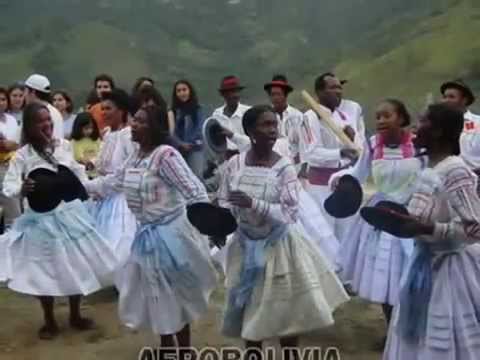
The African inspired music in Bolivia is La Saya. Although it's growing in popularity in Bolivia, the music itself is still misunderstood. In fact, it has been said that the only people who do understand La Saya and can interpret it, naturally, are the Afro-Bolivians themselves. The music involves Andean instruments of the native Aymara people, such as gourds, shakers, and bells along with African percussion, like the drum passed down from their African ancestors. 


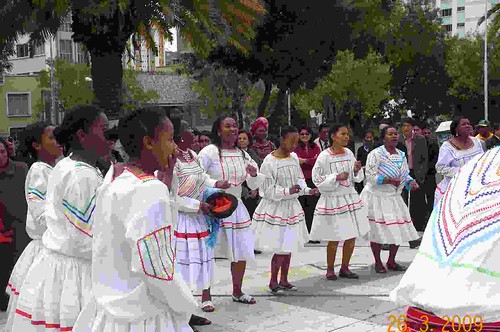
Afro-Bolivians wear Aymara style clothing when performing La Saya music and dance. You will see women wearing bright-colored blouses of many colors with ribbons and a pollera (a multi-colored skirt) with a manta (back cover) in their hand and a bowler hat. The men wear hats, feast shirts, and Aymara style slashes around the waist, and bayetas (pants make of thick woolen cloth, and sandals).


The saya rhythm starts with bells jingling by the Caporal (leader/foreman) who leads the dance. The Caporal leads with the whip (cudgel) in their hand wearing decorated pants and bells near his ankles. The women dancers have a guide of their own as they move their hips, shake their hands, and converse with men playing the bass drum called a coancha.

Tuesday, August 16, 2011

Semantics: Black and Latino

Hacienda de San Jose

This former slave plantation in Perú's District of El Carmen had a Nat Turner type uprising in 1879. Today, a large chunk of Peru's black population reside in El Carmen.


Black and Latino Are Not Mutually Exclusive

The majority of slave ships went to Spanish and Portuguese speaking countries.

An African-American female was in my office going over her job search plan when our conversation somehow led to the discussion of my African-American heritage. In astonishment she said, so you 'are' black. I said, yes, the last time I looked in the mirror I was black. What color did you think I am? Her response was, I would have never known with all that Latin sh...(expletive) on your wall. I then pointed to pictures of Muhammad Ali, John Coltrane, and Miles Davis. They were on my wall too. However, she pointed out that those pictures were overshadowed by my travel pictures to Perú, Cuba, and several other Latin American countries. She made a good point. What I had trouble sinking into her head was that you don't have to be African-American to be black. In each of those Latin-American countries, with the exception of El Salvador, I saw black people who speak Spanish as a first language.


Actress Omarosa is black, but her ethnicity is African-American


On another occasion, a Mexican-American woman told me that her boyfriend is black. Immediately, I stopped her and asked for clarification. I wanted to know if her black boyfriend is Jamaican, Nigerian, Cuban, or what? Oh, you know what I mean, she said. No, I don't know what you mean, I insisted. She finally broke it down to me that her boyfriend is African-American. In such a diverse, multiracial, multicultural society that we live in, it is imperative that we be more specific when it comes to identifying race and ethnicity. There is a distinct difference between the two. For example, in Oakland, where I live, there are black communities that are not African-American. There are Continental Africans, Caribbean Islanders, South Asians, Afro-Latinos, and African-Americans.


Actress Zoe Saldaña is black, but her nationality is half Puerto Rican and half Dominican


A black Puerto Rican woman got irritated with me saying, what you have to understand, Bill, is that when people say 'black,' they are referring to African-Americans. I'm thinking, how ludicrous. If this Puerto Rican woman knew anything about her history, a significant number of 'blacks' were brought to Puerto Rico as slaves. In fact, only 10% of all black slaves came to the US. I never understood why so many people use the phrase' black and Latino' to describe African-American and Latino communities when there are more blacks among the Latin-American population than African-Americans, and this is without counting the one-drop rule.
It is imperative that we be more specific when it comes to identifying race and ethnicity. There is a distinct difference between the two.

I was in a chess game with my goddaughter Daniela of Perú. Before the game started, I said I wanted the black pieces because I'm black. She then touched her arm and said that she is black too. I felt so proud of her. Bottom line, black people come in many different cultures and speak many different languages. Latinos come in many different colors reflecting their indigenous, African European, Asian, and Middle Eastern ancestries.

Saturday, August 13, 2011

The Spanish-English Game

Learning Spanish, Speaking Spanish Practicing Spanish, Spanish
It's almost like a game to see if their English is better than my Spanish or if my Spanish is better than their English

While in transit from Havana, Cuba back to Oakland, CA where I live, I had a short layover at the Benito Juarez Airport in Mexico City. Trying to get directions, I stopped an airport employee and started to ask my question in Spanish. Sensing that I'm not a native Spanish speaker, he snapped, SPEAK TO ME IN ENGLISH! That's when I realized his English is better than my Spanish.

On my second trip to Perú, I met Patricia through her sister, a Facebook friend living in Toronto. She told me in English that her English is better than my Spanish. I accepted that and resigned myself to speak English. However, as we continued to talk, we both agreed (LOL) that we should speak Spanish. As it turned out, my Spanish is better than her English.
 

I felt that he was assuming that I'm just another gringo who can't speak Spanish and I decided to teach his ass a lesson

Now, back in Cuba; I was riding my bicycle along the Malecón (waterfront) with a group of American visitors. A Cuban bicyclist came up beside me and started a conversation in English. I started getting an attitude. I felt that he was assuming that I'm just another gringo who can't speak Spanish and I decided to teach his ass a lesson. For everything he said to me in English, I responded in Spanish hoping he would get the message. Instead, he himself copped an attitude and demanded that I stopped answering him in Spanish because he was trying to practice his English. That's when I began to sympathize with him and comply with his wishes because I was treated the same way when I approached bilingual Latin Americans in the United States when I would speak Spanish to them. 

Just as many Spanish speakers who speak English feel insulted when people assume they are Spanish only; I too feel insulted when people look at me and assume that I'm English only.

In many cases, however, here and abroad, I get in Spanish/English conversations with native Spanish-speakers, and it's almost like a game to see if their English is better than my Spanish or if my Spanish is better than their English, and which ever one dominates, that is the language we speak. Just as many Spanish speakers who speak English feel insulted when people assume they are Spanish only; I too feel insulted when people look at me and ASSume that I'm English only, and that is here and abroad.