Tuesday, September 18, 2012

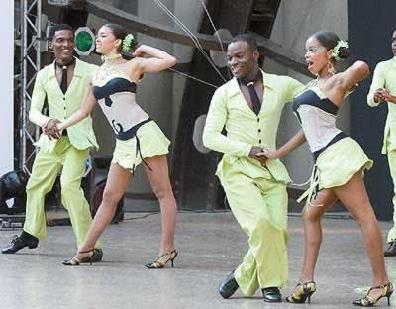
My Salsa-Dance Dilemma


For many years, I used to dance the night away at the Caribee Dance Center in Oakland and Boppers Night Club in San Francisco. Women have told me that I have a nice, smooth dancing style. I then reached a point where I would want to be a show off, like those occasions when I'd approach women I don't know, and I'd get varying forms of rejections; some nice, and some not so nice. They seem to assume that a Black man doesn't know what he's doing on the salsa dance floor. I would then go over and grab a woman who knows me, and we would have a good time. It became quite evident to many of these women who rejected me that they made a mistake as they would later give me a nice, big smile and make themselves available to dance with me. Unfortunately, I only ask once! I've even seen these same women watching me dance while dancing with others--SMH..

I was taught the basic steps of salsa by a Puerto Rican girlfriend while attending college in New York. After moving to California, I started taking salsa classes to learn fancy dance patterns at the La Peña Cultural Center in Berkeley. Because of my love for the music, I put in a lot of practice on my own, sometimes getting up early before work and practicing what I learned in the classes. And as I progressed and impressed with my newly acquired dancing skills, I began to notice some disturbing conflicts. There were women with whom  I clicked as well as women with whom I clashed with on the dance floor. The reason for the clashes depended on where they were from.

For example, I've always had trouble dancing with New York Puerto Ricans. There is just something about the style that I could never figure out, but the women from the Island of Puerto Rico turned out to be better dance partners or “followers.” When I was in Perú, where they also love salsa music, I ran into the same problem---style differences, which is different from Puerto Ricans and Cubans. I ran this concern by instructors whom I met with privately, and none had an answer for me. All they would say is that the woman is supposed to follow me, the man. To a point, I found that to be true. When I was in Havana, Cuba, I met women who were so good that they were able to follow and smoothly adapt to my style. I was so flattered when one Cuban woman asked my date if it was OK to dance with me at the famous Palacio de La Salsa in Havana's Hotel Riveria.

Today, I don't go out dancing like I used to. I enjoy all kinds of Latin music nowadays; bachata (Dominican Republic), champeta (Colombia), llanero (Venezuela), and Afro-Peruvian classics, as well as many others that I'm learning about from my travels and explorations into various Latin-American cultures, especially those of African ancestry.

.

Saturday, September 15, 2012

Mexico's First “BLACK” Liberator

Tribute to Mexican Independence
 

Almost 200 years before General Vicente Guerrero, son of a Black slave mother, led Mexico to her independence, the town of Yanga, led by its Afro-Mexican liberator Gaspar Yanga, gained independence from Spain, creating one of the first free Black towns in the Western world.  Word among the locals says that Gaspar Yanga escaped slavery in the region of the Nuestra Señora de la Concepción plantation in 1570. Regional lore also says that Yanga was a prince stolen from a royal family in what is now known as the Republic of Gabón in Western Africa. The word "Yanga" has origins in many regions of West and Central Africa, including the Yoruba regions in Nigeria where the word means "pride".

Between 1570 and 1609, Yanga led his followers into the mountains located in the vicinity of Pico de Orizaba, the highest mountain in Mexico. By 1600, it was reported that the Yanga joined forces with another escaped slave Francisco de la Matosa and his group of African warriors. 

Yanga's rebellion turned into decades of resistance against colonial Spain. By 1631, the Viceroy of New Spain Rodrigo Pacheco began negotiations with Gaspar Yanga, and struck an agreement of an autonomous region for the African-Mexican community. The first official name was San Lorenzo de los Negros (aka San Lorenzo de Cerralvo). Since 1932, the Mexican town has borne the name of its liberator Gasper Yanga. The town reports approximately 20,000 citizens that is now primarily mestizo (mixed heritage).

Like Yanga's birth, no definitive records are available regarding Yanga's date of death. The first information about Yanga arose in the second half of the nineteenth century by the historian and ex-general Vicente Rivas Palacio, grandson of Mexico's first black president, and Mexico's liberator Vicente Guerrero.


The inscription under Gaspar Yanga's statue reads:
"Negro Africano precusor de la libertao de los negros esclavos fundo este pueblo de san lorenzo de cerralvo (hoy yanga) por acordado del virrey de nueva espana Don Rodrigo Osorio Marzuez de cerralvo el dia tres de octubre del ano de 1631 por mandato del virrey trazo el pueblo el Capitan Hernando de Castro Espinosa H. Ayuntamento Constl. 1973-1976".
English translation: 
African Black liberator and precursor of the black slaves who founded the town of San Lorenzo de Cerralvo (now Yanga) by agreement of the viceroy of New Spain, Rodrigo Pacheco, on the third day of October 1631 by order of the viceroy's pen. Village Captain Hernando of Castro Espinosa H. Ayuntamento Constl. 1973-1976."

 Related Links


Wednesday, September 12, 2012

African Heritage in Chile


Historically, the nation of Chile has been portrayed as a country of European descent, where the African presence and their contributions have been ignored. In 2001, a Chilean organization called Oro Negro (Black Gold) was formed to alter this false perception.

An estimated 5,000-20,000 enslaved Africans were brought to Chile during the mid-16th century, which became the second country in the so-called New World to abolish slavery. 


By the early eighteenth century, there were only 4,000 freed slaves living in Chile. Some historians say that the missing former slaves fought and died as solders in the revolutionary war against Spain. Interracial marriages caused changes in census statistics as well. Many Africans began to mix with Europeans, shaping a whole new ethnic and cultural identity for Chile.
However, the Black population in the city of Arica was considerably high. The city was part of Perú until 1880, when it was taken by Chilean forces during the War of the Pacific. 

At the beginning of the colonial era, Perú was one of the frequent destinations for Blacks who worked in rural and domestic occupations. Most of the Black people that came to Peru were from the Antilles or regions of the Kongo and Angola on the African continent. 

The Black majority of Arica made their presence felt in 1620, when a free Black man named Anzúrez and his friend, also a Black man, were elected as Mayors of Arica. Six months later, an order by Peru's viceroy declared these elections void.
It is documented that the Chilean national dance, the cueca, originating from the Afro-Peruvian zamacueca, had Black elements in its original concept. Also, the famous Historian Francisco Antonio Encina once wrote that 13 percent of the explorers that came to Chile with Deigo de Almagro were Black.

A specific group of Blacks in Chilean history were members of the 8th Regiment of The Andean Liberation Army that fought the Spaniards for independence. That was the Army organized in Argentinian territory where Black slaves fought in exchange for their freedom. As members of the infantry they were exposed to the higher risks during battles. This is seldom mentioned in history books, and that group of Blacks never received any recognition for their contribution to the liberation of Chile.


Sunday, September 9, 2012

Black Latinos Who Deny Being Black


“You are a goddamn Negro! You think being Puerto Rican lets you off the hook? That's the trouble. Too many of you damn Black Puerto Ricans got your eyes closed. Too many goddamn Negroes all over this goddamn world feel like you do. Just because you can rattle off a different language doesn't change your skin one bit. Man, if there are any Black people up on the moon talking that moon talk, they are still Negroes. Get it? Negroes!”

Excerpt from “Down These Mean Streets” by Piri Thomas


R1-00

My goddaughter Daniela of Chincha, Perú
is the only Black in her family.

I was in Burger King conversing with a group of employees who happened to be Latin-American immigrants. We got into a discussion about their manager, and miraculously, I managed to contain an outburst of laughter when they told me that this manager was not Black. The manager and I had spoken before as I looked directly at her dark-brown complexion, her brown eyes, and her wide nose. The only difference between her and me is that I was born in a Black community of St. Louis, MO, and she was born in a Black community of La Costa Chica in Mexico.

I need to point out that this is not an issue with all Black Latinos. I have personal friends of Afro-Latino heritage who are Black and proud. I have Facebook friends from Puerto Rico and all the down to Argentina who celebrate their Black heritage. But for those who do deny being Black, I can certainly understand their confusion. 

In countries where racism is swept under the rug and where interracial relationships and marriages were never outlawed as they were once here in the USA, but encouraged in an attempt to whiten the nation, it is very easy to view yourself by your culture first, and your race second--if at all.

Through my travels and associations with various members of Latin American communities, I've seen families where the colors are like rainbows. Fair-complexioned mothers with Black and White children, and Black mothers with fair complexioned children; Whites with Black and fair siblings, and Blacks with fair and Brown siblings. 

My goddaughter Daniela is a perfect example. She is the only black in her family; and is well loved. She speaks only Spanish and her culture is Peruvian; the only culture she knows other than I who visit her once a year.

If she were to move to the USA where race is more clearly defined, Daniela has no reason whatsoever to detach herself from her culture and embrace a Black population that is foreign to her in terms of language, customs. and social norms. 

However one evening, I was teaching Daniela to play chess, and I told her that I will take the black pieces because I am Black. She immediately tapped her arm and said she is Black too. I felt proud that she recognizes her identity. Of course, living in the hub of Afro-Peruvian culture, and next door to the family famous for Afro-Peruvian music and dance also helped her true identity as well.


In the Dominican Republic, dictator Rafael Trujillo, who ruled from 1931 until his assassination in 1960, told his black population that if they have one drop of white or Indian blood, they are not black, and they believed him. 

A Puerto Rican woman out of Chicago told me that the term "black" only refers to African-Americans. I asked her if she has been to the Puerto Rican towns of Loiza or Carolina where there are still cultural and linguistic ties to Western Africa. 

Instead answering my question, she lashed out at me with a tirade about my being a self-loathing African-American. I had no clue as to what she was belly-aching about. What I tried to remind her, assuming she is as educated as she says, is that there are black people of many different cultures who speak many different languages. In fact, globally speaking, African-Americans are a minority when it comes to the Black race.

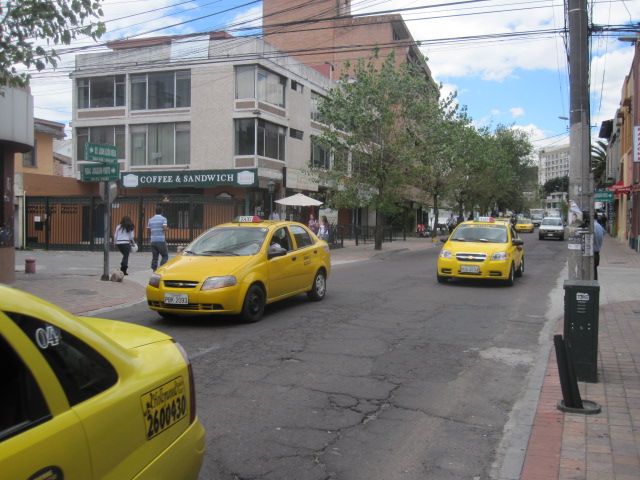
ECUADOR: Flagging Taxis While Black

Scores of empty cabs passed me by, ignoring my signal 
to stop in the Mariscal District of Quito, Ecuador

When I arrived in the Mariscal District of Ecuador's capital, Quito, better known as Gringolandia (Gringo Land), where so many foreigners, expats, and tourists stay, that was when I began to have trouble catching cabs. Droves of empty cabs would pass me by, especially on Friday nights, ignoring my signal to stop. I was offended, but not surprised, when one cab purposely bypassed me to pick up a white man about 25 feet from where I was standing. It seems easier for a black woman to catch a cab, as my friend Gloria walked me to an intersection one evening and flagged a taxi for me. When the cabbie learned that I was from the U.S., he asked me to sit up front with him, and began questioning me about my work and my salary. I inflated the salary. LOL.

One Friday evening while trying to get to back to Gloria's house on the other side of town, I approached a cab who had just let off a white couple. The driver wagged his finger to indicate no way!  However, he abruptly changed his mind when I started waving five-dollar bills. Now that was funny!. It was so interesting how pleased and relaxed the driver became when he learned that I was a harmless African-American tourist and not the feared African-Ecuadorian native. This all seemed too familiar as Black foreigners in the US are often perceived to be less threatening than we home grown African-Americans. I personally know of blacks from other countries who loudly thicken their foreign accents around white folks so they can have the same impact I inadvertently had on this cab driver in Ecuador.

It was an Afro-Ecuadorian friend who works at a local university who told me that there were black guys from his home province of Esmeraldas, where descendants of runaway slaves live, who'd catch a bus to Quito to rob tourists and cabbies in the Mariscal/Gringolandia District of Quito and head back to Esmeraldas. Cabbies, like so many here in the U.S., look at me and assume that I'm just a Black man from the streets with evil intentions. It makes no difference how I carry myself, how I'm dressed, or whether I'm carrying books or groceries. They fear the color of my skin, and nothing more. The Maricscal District of Quito, Ecuador made me feel right at home!
.


Thursday, September 6, 2012

Layover in El Salvador

R1-5
Costa del Sol, El Salvador

Upon arrival at the Comalapa Airport about 7 am, I knew I had a seven-hour layover before catching my next flight to Lima, Perú. I thought this would be an inexpensive way to do more exploring of Latino culture, Salvadorean style. I already did my homework before making this trip and I knew exactly where and how I wanted to spend the next the next seven hours of my layover. I did not want to go to the nations capital, San Salvador, because it was a 45-minutes cab ride each way, and I wanted to make the best of my hours while waiting for my next flight.

Once I passed through immigration and security, I paid $10 USD to get a tourist card to leave the airport. El Salvador now uses US currency, however, I did get hold of an old El Salvadorean paper currency as a souvenir. Once outside the airport, a cabbie propositioned me. He, like so many others I met, speaks no English, so I got plenty of practice on my Spanish. We negotiated a fare of $60 USD where he would show me around the area for the next three hours. First, we went to Costa del Sol (Sun Coast) where they have a lot of beaches and seafood restaurants.

R1- 0A
Neighborhood about 30 minutes from the Comalapa Airport in El Salvador

Upon arriving in Costa Del Sol, two young men ran out towards our cab and admonished us (hustled us) to go into the restaurant where they were working, Café Yessenia. My cab driver had it made-in-the-shade. In addition to taxi fare, he had a nice seafood dinner, and a fresh coconut on me. We both relaxed in the shady restaurant for a time before we started riding around and touring the area. We stopped in a couple of nice small towns, and at two or three different beaches.

Enough time had passed when I was ready to get back to the Comalapa Airport and get checked in two hours before my international flight to Lima. I left El Salvador feeling that my seven-hour layover was well-spent and looked forward to other long layovers during my travels.

Monday, September 3, 2012

Puerto Rico's Black Father of Public Education

 Rafael Cordero monument in Juana Dias, Puerto Rico 
 The Father of Public Education in Puerto Rico
October, 1790–July 5, 1868 
  
Rafael Cordero was born into a poor family in San Juan, Puerto Rico when African slavery was still being practiced on the island. It was not until March 22, 1873, when slavery was abolished, but Cordero was free because his parents were free. 

Cordero and his sister were self-educated because they were rejected from area schools because of the color of their skin. Rafael's love of literature and his determination to teach and educate himself helped him to develop the skills and preparation to teach primary school where he provided education to black children, and as time progressed, other children regardless of race or social standing. His school was the first integrated school on the island. Cordero also owned his own cigar making shop.

Rafael Cordero, who owned his own cigar shop, valued education so much that he did not charge anyone and accepted all who were unable to afford an education otherwise. This free school was conducted out of his home lasting 58 years at 315 Luna Street in San Juan. There he taught reading, calligraphy, and mathematics. 

Because of his progress and service, he received the Virtue Award from the Economic Society of the Friends of Puerto Rico. He was given 100 pesos, which half he used to buy books and clothes for his students and the other half to give to the homeless. The Puerto Rican government started paying in $15 per month in grants. His students grew to be fighters for the abolition of slavery on the island.


Puerto Rican people's love and respect for Rafael Cordero was evidenced by the fact that more than 2,000 people attended his funeral when he passed away on July 5, 1868. He has been honored in poetry, immortalized in a painting, which can be seen in the Puerto Rican Athenaeum, one of Puerto Rico's chief cultural institutions serving as a museum, school, library, and performance hall for the greater Puerto Rico. 

The house at 315 Luna Street, where Rafael Cordero taught, was remodeled by the Puerto Rican government and registered as a historical site in the National Register of Historical Places. There is a plaque on the outside with a statement regarding the historical significance of the building.


The Teachers' Association of Puerto Rico annually awards teachers who has distinguished themselves in the field of public or private education with the Rafael Cordero National Medal, the highest award a teacher can win on the island. 

There are various schools named after him in Puerto Rico, New Jersey, and New York. In 2004, the Roman Catholic Church began the process of Cordero's beatification, the first step on the road to canonization.