Showing posts with label latin american racism. Show all posts

Friday, July 17, 2015

Black on Black Racism in the Dominican Republic


Haitians and dark-skinned Dominicans 
confront racism on a daily basis.

Here in California, I don't meet too many people from the Domincan Republic as most of them are on the east coast of the USA. However, I did recently meet a couple of light-skinned Dominican woman at a bus stop where we got into a brief conversation. Both were fine looking and rather friendly compared to what I hear about Dominicans and their attitudes towards black people.

One thing that stood out about them is that their hair looked as though they were fresh from a beauty parlor. This is a big deal in the Dominican Republic, making your hair look as straight and Eurocentric as possible. Although, these two women were of color, I thought they would have looked just as good with curly or frizzy hair. However, anything making reference to an Afro-centric or Haitian look is beneath the average Dominican.

In a country where 90% of the citizens have African ancestry, the self hatred among Dominicans of color is unfathomable. Black Dominicans have gone as far as lynching black Haitian-Dominicans trying to drive the Haitians, even though they were born in the Dominican Republic, back into Haiti. 

The African-American woman who wrote the article below is black and proud, and describes a conflicting experience living in the Dominican Republic. 

My only question to her would be why did she choose the Dominican Republic to live and teach English versus other Latin-American countries where racism and internalized racism is not nearly as steep? She says, going to the Dominica Republic would give her a break from the racism that she experiences in the US. Wow was she mistaken.

Below is the link to the article followed by a copy of the actual article itself.


When I lived in the Dominican Republic, there was a point when the jeers from the streets, shouts of “Arréglate ese pelo!” (Fix that hair!) and mocking gestures about my prominent pajón (afro) became too much to deal with. In a country of complex racial dynamics, where straightened hair is a social currency and billboards depict curly-haired women with the headline “Your hair deserves better,” natural or curly hair, colloquially referred to as pelo malo (bad hair—also a term used in the black American community), is sometimes viewed as a marker of Haitian identity. While many Dominicans vehemently deny the role of race in the current controversy over the deportation of Dominicans of Haitian descent and Haitian migrants, the treatment I received while living in the Dominican Republic (and often being mistaken as Haitian) suggests the contrary.

As a black American from the South, I initially (and perhaps naively) thought I’d catch a break from the daily racism I experienced in the U.S. As with black Americans, there are Dominicans (and Haitians) of every shade. I welcomed the idea of living in a country where most people looked like my family members and me, as 90 percent of the Dominican population has black ancestry.
However, it wasn’t long before I encountered a familiar, yet foreign, racism. While I realize that experiences vary and my story is one of many, it is certainly not the exception. Whether in the form of racial slurs or extreme violence, both Haitians and dark-skinned Dominicans alike confront racism on a daily basis. After continuously feeling like a walking target with my sizable pajón, I decided to carry hair ties for the days that the taunts became unbearable.

I arrived in Santiago, Dominican Republic as an English professor one month before Sentencia 168/13, a Supreme Court ruling that revoked the citizenship of Dominican residents whose parents were born outside of the country as far back as 1929, unless they could regularize their status. In the months that followed, lynchings of Haitians became more frequent, according to media reports. Black American friends that had come to study abroad were harassed and interrogated by police about their nationality. After my friends explained that they were Americans studying abroad, the officers scoffed at them, laughing that “esa se cree americana pero es haitiana” (this one thinks she’s American, but she’s Haitian). Even my Dominican host sister, whose surname was French in origin, encountered complications with government agencies that questioned her Dominican identity. I began to realize that the recurring treatment my colleagues and I were receiving was probably a result of intensified anti-haitianismo following the Supreme Court ruling.
Most of my fellow U.S. English professors condemned the ruling, though others viewed it as the Dominican Republic exercising its sovereign right to regulate immigration within its borders. Some of my Dominican and Haitian students criticized the ruling as discriminatory, while others adamantly defended the court’s decision. However, few dared to denounce it as racist.

I was no stranger to discrimination in the Dominican Republic, having endured taunts, repeatedly been denied entry to clubs, and received regular slights during my time there. With both the history of Hispaniola and my own experience in mind, I know the court’s ruling was founded upon anti-haitianismo that the country has yet to reconcile. In the words of Junot Díaz, “if we do not begin to practice the muscles of having a possessive investment in each other’s oppressions, then we are in some serious trouble.”

Tuesday, June 2, 2015

Michelle Obama “Dissed” on Spanish TV


Rodner Figueroa, the Emmy award-winning host of a major Spanish television station known as Univisión, was fired after comparing first lady Michelle Obama's appearance to that of someone from the cast of the "Planet of the Apes." This inflammatory comment occurred during his live segment on the entertainment news show "El Gordo Y La Flaca." Because he is the son of a black man from Venezuela, he didn't think his comment would create such a reaction.

After his firing, Univisión made a public statement that Mr. Figueroa's comments about the First Lady, Michelle Obama, was reprehensible and does not reflect the views and opinions of Univisión. 

But, here is the irony behind Univisión's statement;  Univisión and other Spanish television networks perpetually discriminates against Latinos of color in their programing as pointed out in my earlier blog post So Few Latinos of Color on Spanish TV? It is as though Univisión wants to sweep their racism under the rug by firing and disassociating themselves from Rodner Figueroa.


Wednesday, August 20, 2014

Racist Encounter of the Peruvian Kind


In my first trip to Perú where I was undergoing Spanish-language intensive training for my advanced certificate, I experience a subtle but, rude awakening to Peruvian racism. Perhaps, as a black person from the USA, I should have been used to it, such as the evening I was in the predominately Latino Mission District of San Francisco. I was on my way to teach a résumé-writing workshop in Spanish at the Central American Resource Center. It's been a while since I was in this area as I live across the bay in Oakland; thus, I was somewhat lost. I saw two white patrol officers walking their beat, and I thought to myself that they would surely know which direction to take. And they did.

A queasy feeling came over me by the way one of the officers reacted to me when I approached them. It was as if he perceived me as a potential threat even though I was loaded down with a bag filled with workshop materials. The officer, without saying a single word, pointed in the direction that I should be walking with his nightstick. It was so unlike the manner in of someone who is sworn to protect and serve.Unfortunately, this behavior does not seem to be restricted to the USA

One evening, in the Barranco District of Lima, Perú where I was staying, I was in the mood to go out and party. I started walking the streets looking for a place to exchange some of my American dollars into Peruvian currency. Down the block, I saw a police car parked at the corner of the main square. Surely, they would know, I thought to myself. As I got up close to the police car, I noticed their window up and shut tight as they simply looked at me. I motioned for them to roll down the window because I wanted them to hear my question. The officer on the drivers side lowered the window about an inch. As soon as they heard my foreign accent and request to exchange my American dollars, they realized that I was not Afro-Peruvian. The police car's window was immediately rolled all the way down, and both officers suddenly became jovial as they happily gave me the directions that I needed.

I walked away with feelings of frustration and empathy on behalf of black Peruvians and how I could certainly relate to their experience of racism in their own country. Racism to which so many Peruvians I've personally heard vehemently deny exist. What Perú and other Latin-American countries do have over the US, however,  is that you hardly hear of any hate crimes or police brutality motivated by race.

Friday, July 4, 2014

Any Guilt Feelings Among Black Americans Traveling in Latin America?


Terri, an African-American member of a Facebook forum, Brothers and Sisters in Latin America, posed a question to those of us who have lived or visited a Latin-American country. She wanted to know if any of us felt any guilt or felt badly that we, as Americans, get better treatment and more respect than the black citizens of the countries we visit.

The reason I personally do not have guilty feelings is because, as much as possible, I try to connect with the black community in the countries to absorb as much as I can about their black experience and history. Monetarily, I offer support in ways that I can afford, but at the same time, I do not allow anyone to take advantage of me. 

In the commercial district of Cartagena, Colombia, I came across a black woman selling her wares. Although, I saw nothing that I wanted or needed, I handed her some money just to be helpful. There were other times, in certain countries, that I blended so well with the black community that I too sometimes experienced disrespect due to racial prejudice. 

In Chincha, Perú, an Afro-Peruvian friend escorted me to a bus station to inquire about the price of a ticket to Ecuador. The man shouted the price at me in a tone of voice expressing doubt that I could even afford it. In Quito, Ecuador, I had trouble catching cabs in certain parts of town, especially at night, because I was profiled as an Afro-Ecuadorian thug. One Friday night I saw a cabbie drop off a white couple, and when I tried to enter, he wagged his finger in utter defiance. I then waved two $5 bills, LOL; he changed his mind instantly. Once in the cab, he was pleased to learn that I'm an African-American traveler and not an Afro-Ecuadorian native...sigh!

Tamara, another one of our African-American members, was generally treated with warmth and respect in her travels, however, she spoke of one isolated incident in a department store in Lima, Perú. She saw some soccer jerseys that she wanted to get for her nephew. She tried to get the store clerk's attention, but the clerk turned and walked away. Within minutes, the store clerk returned with a man who was possibly a security officer. When Tamara addressed her in English, the clerk's attitude changed abruptly giving Tamara a very pleasing smile. Tamara was so turned off by the obvious racial profiling that she decided to shop somewhere else (good for Tamara!).
 .
Thierry, an Afro-Latino member of the group stressed that in Latin America, tourists of “any” color get treated better than local Latin-American citizens, regardless of their race. I tend to agree. I believe that if I stayed in a fancy hotel speaking English only, and perceived as having a pocket full of money, I would not have experienced any racism. In Latin America, money “whitens” your skin.

He [Thierry] also added that the great hospitality that visitors from other countries receive from Latin Americans may also be a way for them to take advantage of you, i.e., to charge you much higher prices—the famous gringo tax. Fortunately for me, my attempts to establish bonds with local citizens and immerse myself in the language and cultures of the barrios (the hood) results in cheaper prices for food, lodgings, entertainment, and souvenirs, which always saves me an enormous amount of money.


Sunday, June 29, 2014

TEAM ECUADOR: From the Black Ghettos to World Cup Competition


I have social, sentimental, and Afro-centric reasons for loving Team Ecuador

When I off-boarded my plane in Quito, Ecuador, the security staff detected a large can of insect repellant in one of my bags. They were impressed when I told them that I'm going to Valle de Chota (Chota Valley), a hot, sticky region consisting of Ecuador's black ghettos that produces big time soccer stars in national and international competition. Although, Ecuador was eliminated in the most recent World Cup competition (2014) with one win, one loss, and one tie against France, one of the world's toughest teams, Team Ecuador remains my sentimental favorite.

In my Spanish-speaking Facebook account, I posted the following message and repeated it in English on my English account:

“No soy Ecuatoriano; sino hincha del Equipo Ecuador, sobretodo los Choteños.”
“I'm not Ecuadorian; but a fan of Team Ecuador, especially of those from Chota Valley

I'm sure those who read those messages were wondering about my true nationality. Even my supervisor at work alluded to the fact that the Team USA is also playing, aren't I a fan of them?. Well, I am an American and also a US Navy veteran having served my country overseas under oath to defend this country against all enemies foreign and domestic, so it's not a question of patriotism. I have social, sentimental, and Afro-centric reasons for loving Team Ecuador. 

 
El Juncal in Ecuador's Chota Valley

It was Saturday, December 5, 2009 when I stepped off the bus in the town of El Juncal, in the Valle de Chota (Chota Valley) region of Ecuador. I immediately felt very much at home in a community where everyone looks like me, even though it was evident from my Spanish, my attire, and my overall demeanor that I am not from around those parts, let alone Ecuador. At first, people were suspicious of me, then that changed once we started communicating. Even the police officers who questioned me about my presence were pleased.


Agustín Delgado

Chota Valley is Ecuador's second largest black community behind Esmeraldas. This is the hometown of 30 or more of Ecuador's top soccer stars such as the retired Agustin Delgado, the all-time leading scorer for the Ecuadorian national team. He was named by Ecuador's president as head of the Afro-Ecuadorian Development Council as Delgado, and other Afro-Ecuadorian soccer stars hope to use their influence to improve the overall quality of life in their country's black communities. Nationally, 70% of Afro-Ecuadorians live in poverty, and in towns like El Juncal, where they only have two paved roads, no high school, or permanent medical clinic, the number is as high as 99%.  El Juncal has struggled against an endemic of racism which has left it perhaps the poorest community in Ecuador. 


The soccer field where boys practice

Augustín Delgado established La Escuela de Fútbol (the Soccer School) in El Juncal where more than 300 boys and young men arrive every afternoon to hone their skills. There is always a game going on as they practice endlessly. In some ways, poverty has proven to be a successful training method because soccer balls roll faster down the dirt lot in El Juncal than they would on a grass field in a big high-end stadium. Therefore, players must learn speed and control. The school, however, is not only interested in providing young black men with a way out of the ghetto to the bright lights of soccer stadiums. There is an emphasis on building self-reliance, self-esteem, and literacy. 

Like most Latin Americans, Ecuadorians ardently love soccer. In 2002, Ecuador's national team qualified for the first time for the World Cup finals – a fact attributed to the slow integration of Afro-Ecuadorians. For many towns in Chota Valley, success on the soccer field remains the best hope for receiving government attention. And that attention has just begun to happen.


Monday, April 7, 2014

I Aroused Suspicion at a Peruvian Party


It was almost one year after my first trip to Perú, and was exhilarated to learn about a Peruvian event in San Francisco, across the bay from where I live in Oakland. The party was at the Fina Estampa Restaurant featuring, directly from Perú, popular singer Pepe Vazquez.

I arrived at the front window early to get a good seat, and paid my $35.00 entry fee to a heavy-set Peruvian gentleman who seemed to be either the manager or owner. Upon entering, I immediately set my bag and over coat down in the chair where I wanted to sit, then ran up to the second level to order a meal—arroz con pollo (chicken and rice). Having eaten Peruvian food at other venues in the US and in Perú, I was not impressed with my meal, but it was enough to energize me for a full night of partying.

 Fina Estampa Restauran, San Francisco, CA

After eating, I went back downstairs and ordered something from the bar that I had not had since visiting Perú—a pisco sour (a cocktail made from Peruvian brandy). As I went back to my table, I noticed that the heavy set Peruvian manager/owner was eying me suspiciously with that familiar look of fear and concern. Perhaps, he was wondering what interest would a black American have in a Peruvian environment. Did he think I was casing the place planning a robbery?. There were other blacks in the place, but they are Afro-Peruvian. In fact, the lead singer Pepe Vazquez and one of his band members whom I met a week prior to this event at a pollada (chicken dinner-party) are also Afro-Peruvian. I also had the opportunity to introduce myself and chat with singer Pepe Vazquex while dining in the upper level.

I brushed off this man's reaction to me because, with a picso sour in my hand, I was filled with fond memories of Perú. Other than Cuba, Perú was my most memorable and heart-warming experience out of the nine Spanish-speaking countries that I've visited.


 Singer Pepe Vazquez
1961-2014—RIP

When I think about it, I would have happily and gregariously explained my interest in Peruvian culture if that manager/owner had the intestinal fortitude to simply “ask!” He was totally unaware of the time I spent in Lima, the Peruvian capital, where I took a Spanish-language intensive course, and  hung out in various parts of the city, This gentleman was clueless to the fact that I spent weekends with Peru's famous black musical family, the Ballumbrosios. This suspicious gentlemen did not know that I would be taking many more trips to Perú on my vacations because I fell in love with the country, the culture, and the people.

However, despite the judgement of this poor, frightened individual, I had a wonderful time. When Pepe Vazque to came out to sing, he gave me some “dap“ (a type of greeting when two men knock their fists together in lieu of a handshake). In between sets, the dj played salsa music, which gave me a chance to go on the dance floor and show off what I can do. Yes, this black American can definitely “throw down” on some salsa. That gentleman did not know that I grew up in what used to be the salsa music capital, New York City (now, it's Cali, Colombia). He didn't know anything about me . He certainly wanted to know, but lacked the moral fiber to simply “ask ” Meanwhile, I partied hearty until 3 AM.

Sunday, September 22, 2013

Controversy over Black Girl Winning a Latina Beauty Contest


From looking at a wonderful photo of a young Afro-Dominican beauty queen, Jakiyah McKoy, 7, crowned Chiquita Delaware (Little Miss Hispanic Delaware) posted by journalist Dash Harris, there was some speculation expressed about the controversy surrounding the pageant winner. As I myself explored this matter, I learned that the eight finalists, all very intelligent with pleasing personalities, had to demonstrate their talents by dancing or singing, modeling along the catwalk, and answering questions. Ironically, Jakiyah was the only contestant of African heritage, and the only contestant required to prove her lineage as a Latina.

After being announced the winner, there was an uproar stating that she is not the best representative of Latin beauty. It never ceases to amaze me how so many Latinos that I meet in my personal life who are so oblivious to the racial diversity in their own community. I hate to bust some folks bubble, but not all Latinas look like Jennifer Lopez. I’m not Latino, yet I myself have personally met and rubbed elbows Latinos who look like Denzel Washington, Merryl Streep, Mahmoud Ahmadinejad, and Sun-Young-Moon. Where have these folks who criticized the winner been all of their lives assuming you have to be a certain color to be Latino. As I stated on another blog post, I’ve been in Latin-American restaurants and grocery stores in the US, Perú, and Venezuela that were owned and staffed by Chinese, and if I didn’t speak Spanish (or Cantonese), I didn’t eat. It was simple as that!

The pageant winner’s Latin-American bloodline goes back to her grandmother who was born in the Dominican Republic. Jakiyah herself was born in Brooklyn, New York where her mother currently lives. The little Miss Hispanic Delaware currently stays with her father in the city of Wilmington, Delaware. She likes to sing, dance and watch movies with her grandmother. Jakiyah McKoy has one brother, Shad, and a sister, Jamiyah. She loves spending time with her aunts, uncles, and her cousins and loves her godmother Relly. Her favorite pastime is drawing.

Saturday, July 20, 2013

George Zimmerman and His Latino Roots


When I listen to the news and read articles addressing George Zimmerman's race, it amazes me how educated people who should know better get so confused. Some argue that he is White, and others argue that he is not White, but Latino. Even George Zimmerman himself appeared confused; or at least trying to win the sympathy of the non-White public by describing himself as Latino, a fellow minority, and not White. Why can't he be both, considering that White is a color and Latino is a culture?

Based on my own travel experience, and my growing up in a mixed African American and Latino community, I've observed that Latin American people are collectively made up of White, Black, Asian, Middle Eastern, and of course, Indigenous. Oops, I forgot to mention Jewish people. George Zimmerman is the son of a Mestizo mother from Perú and a White father whose name, Zimmerman, derives from the German last name Zimmermann, which means carpenter. In essence, George Zimmerman is White and half Latino - a no-brainer! 

In terms of racial views, no one is born racist; not even George Zimmerman. Racism generally originates with family and community influences. Even in the Latin American countries I've visited, I've noticed blatant racial discrimination against people of color, particularly against the Indigenous and the Blacks. I remember walking into a bank in Cartagena, Colombia, a city filled with Blacks and Browns, but the bank employees, including the security officer, were so white that I felt that I needed sunglasses to see what I was doing.

Here in the US, I've met Latinos of all colors who mix well with African-Americans having the understanding that, despite language and cultural differences, both communities face similar issues of American racism. Yet, I've met other non-black Latinos who are only prejudiced against African Americans, and not Afro-Latinos. The question that lingers in my mind is do these Latin American immigrants dislike African Americans, in general, or is it just the ghetto types who exhibit all of our negative stereotypes (maybe someone reading this can help me get more clarification). When I'm shopping in Oakland's Spanish-speaking district to practice my Spanish, I can't help but notice how some people warm up to me thinking that I might be Afro-Latino, and not African American. And of course, there are non-Black Latin Americans who dislike all Blacks, regardless of ethnicity.

While African American people, including I, are disturbed over the George Zimmerman case, I'm equally disturbed by the actions of some Black people who are contributing so heavily to the oppression of the African American community? Yes, there are a lot of George Zimmermans out there; some even in police uniforms, but it is mostly Black people who are doing the George Zimmerman dirty work. Where is the outrage, here? When will the African American community wake up and realize that we have enemies within our own borders?

Friday, December 7, 2012

Who's Planting the Racial Seeds?

While waiting at the checkout line in a store one evening, I engaged in a conversation with an El Salvadorean woman, and her child who could not have been more the 6 years old. The little girl asked me, what is a black guy doing speaking Spanish? I can tell by her warm demeanor that she did not mean any harm. In fact, the minute she saw me, she gave me a friendly, but curious gaze. Although, her mother calmly scolded her for making that comment, I high-fived the child wondering who planted the racial seed in her heart. In any event, I would love for this little girl to meet my goddaughter Daniela who is Black and speaks Spanish only!
On another occasion when I used to do recruiting for a federally sponsored job-training program for youth,  a young Latina came into my office with her mother who did not speak any English. Out of fearful concern for her daughter, she asked me if there were a lot of Blacks in this institution. I just bit my lip to keep from laughing. The mother must have thought I was “different” because we were speaking Spanish (LOL).
Fortunately, her daughter was not concerned and obviously did not buy into the racial prejudice of her mother. She went into the training program and got along well with everyone, regardless of color.


Monday, October 29, 2012

Peruvian Imitation of Mr. Jim Crow

El Negro Mamá 
(Dumb Black guy)

A White comedian by the name of T.D Rice in the 1820s wore a black face dancing and grinning, and masqueraded as a happy sambo making mockery of African-Americans in theaters by behaving in the stereotypical coon fashion. TD Rice became known as Jim Crow, setting off the rave of the times--the black face minstrel shows.

Thanks to Afro-Peruvian human rights activist Mónica Carrillo, a similar racist TV show was taken off the Peruvian airwaves, which promoted negative stereotypes of Afro-Peruvians. Mónica's organization, LUNDU, has received insults and even bomb threats for their role in eliminating this show. And to this day, I'm baffled why so many Peruvians insist that there is no racism in their country. The same day El Negro Mamá was taken off the air, LUNDU was celebrating the Day Against Racism by denouncing over 1000 racist news reports in the Peruvian media attacking Afro Peruvians with slurs such as "monkeys, gorillas, and baby maker stallions.

Comedian Jorge Benavides

The popular TV show El Negro Mamá was played by Peruvian comedian Jorge Benavides (above), who like T.D. Rice, donned black on his face playing the role of a mentally retarded, dingy thief, reinforcing stereotypes against Blacks. Benavides, a mestizo actor wearing a rubber mask playing the wild-haired character, sports silly clothes and speaks slowly with an exaggereated accent and bulging eyes. El Negro Mamá is not only portrayed as lazy and stupid but simmering with criminal intent. He is often involved in thievery, drug dealing and common thuggery and even occasionally a rape.


Mónica Carrillo, founder and leader of LUNDU, 
an Afro-Peruvian civil rights organization
 
So, what attracted me to Perú? As one who loves to explore the Black experience in Latin-American countries, while working to improve my Spanish; Perú was at the top of my list because of singers like Susana Baca and drummer/choreographer Rinaldo Campos who is the late founder of the internationally acclaimed dance troupe Perú Negro, Perú's answer to the Alvin Ailey Dance Theater of Harlem, not to mention the famous family of Amador Ballumbrosio, with whom I stayed on two of my trips. It was Afro-Peruvian singers, poets, and writers like Nicomedes Santa Cruz) who inspired my first trip to Perú.


Related Posts on Black Perú

Friday, October 5, 2012

Latino Haters


What is it?... Whatever you might want it to be!
What is it?... Why you wanna hate on me?
What is it?... I ain't even trippin' dog!
What is it?... I mo' show you how to fall! 
                                                             -- Frontline, 2003

An overwhelming majority of the e-mails and comments I get regarding my blog posts are positive, uplifting, and most of all, appreciative. However, every now and then, I get harsh correspondence from non-Black Latino haters who have stereotypical issues with the African-American community and/or feel because I'm African-American that I should only be listening to hip-hop and not bachata, eating collard greens and not pupusas, or reading the works Langston Hughes and not Nicolás Guillen. 

In other words, I must hate being African-American or simply bored with my own ethnicity for me to be learning Spanish and exploring Latin-American cultures. I can only suspect that these haters have had bad experiences with a few African-Americans, casting an evil shadow on the rest of us. Life has taught me that in every community, regardless of color or ethnicity, you will meet the open-minded and the closed minded, the well-informed and the ignorant.

I received one anonymous message from a hater who went on to say how we Blacks are a mess and that he does not want to be associated with Black people, even though he has a Black Haitian grandmother. After making his remarks, he left his e-mail address in case I wanted to debate him. I not only responded to his comment on my blog, I sent him two e-mails taking him up on his offer of a debate; thinking that I might learn something, or at least, expand on my awareness. He never responded.

A Puerto Rican man from Minnesota complained about a museum in San Juan that is dedicated to Puerto Ricans of African ancestry. He felt the museum should be dedicated to the Spanish and the French. I reminded him that if he did not want to celebrate Black heritage that there are many more museums on the island that specifically excludes Black Puerto Ricans. His only response was about the young, fatherless African-American males he observed walking and holding their crotches at the same time. He too declined to debate me on his stereotypes. He did not want to hear about the respectable African Americans who actually are hard working, studious, and family oriented. If I can only get him to visit my church where there are Black professionals, entrepreneurs, writers, artists, and of course, spiritual leaders.

Then there was Alvaro, a former co-worker from Chile who made negative comments about Blacks in the ghetto saying they don't read. My mind went back to the days when I was growing up in the largest ghetto in the US, Harlem, NY, when I acquired my first library card at the age of nine. These libraries were well-patronized. Even my fifth-grade teacher, Ms Lawson, made everyone in class not only get a library card, but stroked us by putting stars next to our names on the bulletin board every time we finished reading a book, and mind you, this was a “public” school. 

My supervisor twisted Alvaro's arm to apologize, shake hands, and make up, but because Alvaro could not articulate a rationale for painting all Blacks with the same brush, I called him on his insincerity and dismissed him. 

Unlike Alvaro, most hateful Latinos I've met, seldom ever make these comments to Black people directly, unless it is behind the shield of the Internet. Alvaro seemed to have felt because I speak some Spanish and often travel to Latin American countries that I was not “Black” enough to be offended. Even his country, Chile, has a history of Black heritage due to slavery (see my blog post African Heritage in Chile). 

It is of my humble opinion that good, honest communication with an open mind can solve a lot of these hateful issues.

Sunday, September 9, 2012

ECUADOR: Flagging Taxis While Black

Scores of empty cabs passed me by, ignoring my signal 
to stop in the Mariscal District of Quito, Ecuador

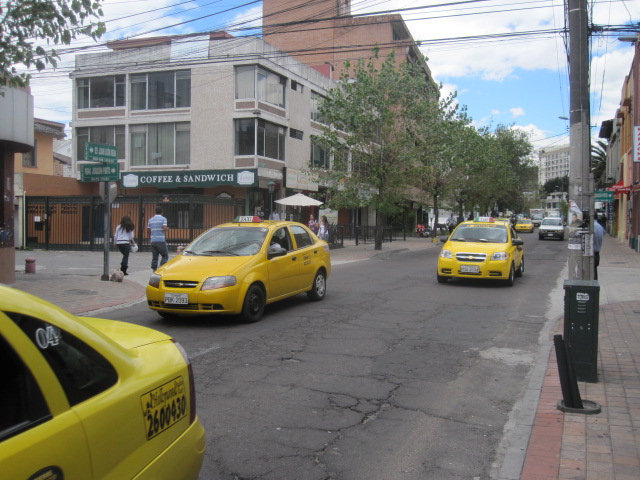
When I arrived in the Mariscal District of Ecuador's capital, Quito, better known as Gringolandia (Gringo Land), where so many foreigners, expats, and tourists stay, that was when I began to have trouble catching cabs. Droves of empty cabs would pass me by, especially on Friday nights, ignoring my signal to stop. I was offended, but not surprised, when one cab purposely bypassed me to pick up a white man about 25 feet from where I was standing. It seems easier for a black woman to catch a cab, as my friend Gloria walked me to an intersection one evening and flagged a taxi for me. When the cabbie learned that I was from the U.S., he asked me to sit up front with him, and began questioning me about my work and my salary. I inflated the salary. LOL.

One Friday evening while trying to get to back to Gloria's house on the other side of town, I approached a cab who had just let off a white couple. The driver wagged his finger to indicate no way!  However, he abruptly changed his mind when I started waving five-dollar bills. Now that was funny!. It was so interesting how pleased and relaxed the driver became when he learned that I was a harmless African-American tourist and not the feared African-Ecuadorian native. This all seemed too familiar as Black foreigners in the US are often perceived to be less threatening than we home grown African-Americans. I personally know of blacks from other countries who loudly thicken their foreign accents around white folks so they can have the same impact I inadvertently had on this cab driver in Ecuador.

It was an Afro-Ecuadorian friend who works at a local university who told me that there were black guys from his home province of Esmeraldas, where descendants of runaway slaves live, who'd catch a bus to Quito to rob tourists and cabbies in the Mariscal/Gringolandia District of Quito and head back to Esmeraldas. Cabbies, like so many here in the U.S., look at me and assume that I'm just a Black man from the streets with evil intentions. It makes no difference how I carry myself, how I'm dressed, or whether I'm carrying books or groceries. They fear the color of my skin, and nothing more. The Maricscal District of Quito, Ecuador made me feel right at home!
.