Showing posts with label black Peruvian. Show all posts

Tuesday, September 13, 2016

The Mother of Afro-Peruvian Dance and Theater


Victoria Santa Cruz
 
My heart swelled as this little Afro-Ecuadorian girl in the video below, no more than five years of age, passionately shouts her poetic black pride in her black community of Esmeraldas, Ecuador. She blatantly reminded me of the poetry by Afro-Ecuadorian poet Nelson Estumpiñan Bass, a contemporary and friend of African-American poet Langston Hughes.

However, it was the late Victoria Santa Cruz, an Afro-Peruvian choreographer, composer, and activist. and the mother of Afro-Peruvian dance and theatre who herself was about 7 years old when she encountered her first taste of racism as an Afro-Peruvian – an experience that has been immortalized in her poetry in song form, Me Gritaron Negra (They Call Me Black).

Despite her young age, she delivered her poetic lines with intensity, and this video is just one example of Santa Cruz’s legacy. In her poem, Santa Cruz rejects Eurocentric beauty standards and decides to move forward with black pride. 

When Victoria was young, she was the only black person among her group of friends. “One day there was a little girl among them with blond hair who stated to her friends, “if this little black girl wants to play with us, I’ll leave!” It came as a big surprise when her friends concurred, telling Victoria that she could leave in compliance with the dictates of the blond girl, and yes that hurt her.

Victoria never forgot the experience, and it changed her to the point of being stimulated to learn what it means to stand on her feet without looking for someone to blame; suffering but discovering. She began to discover life. She never told her parents about the incident.

Performing was Victoria’s claim to fame. Around the year 1960, Victoria and her brother Nicomedes started a theater company named Cumananá, and revitalized the Afro-Peruvian culture.” Victoria, for example, revitalized an ancient dance with roots in African, Spanish, and Andean roots called the zamacueca.


A young Afro-Ecuadorian girl 
proclaims her black pride

Monday, April 7, 2014

I Aroused Suspicion at a Peruvian Party


It was almost one year after my first trip to Perú, and was exhilarated to learn about a Peruvian event in San Francisco, across the bay from where I live in Oakland. The party was at the Fina Estampa Restaurant featuring, directly from Perú, popular singer Pepe Vazquez.

I arrived at the front window early to get a good seat, and paid my $35.00 entry fee to a heavy-set Peruvian gentleman who seemed to be either the manager or owner. Upon entering, I immediately set my bag and over coat down in the chair where I wanted to sit, then ran up to the second level to order a meal—arroz con pollo (chicken and rice). Having eaten Peruvian food at other venues in the US and in Perú, I was not impressed with my meal, but it was enough to energize me for a full night of partying.

 Fina Estampa Restauran, San Francisco, CA

After eating, I went back downstairs and ordered something from the bar that I had not had since visiting Perú—a pisco sour (a cocktail made from Peruvian brandy). As I went back to my table, I noticed that the heavy set Peruvian manager/owner was eying me suspiciously with that familiar look of fear and concern. Perhaps, he was wondering what interest would a black American have in a Peruvian environment. Did he think I was casing the place planning a robbery?. There were other blacks in the place, but they are Afro-Peruvian. In fact, the lead singer Pepe Vazquez and one of his band members whom I met a week prior to this event at a pollada (chicken dinner-party) are also Afro-Peruvian. I also had the opportunity to introduce myself and chat with singer Pepe Vazquex while dining in the upper level.

I brushed off this man's reaction to me because, with a picso sour in my hand, I was filled with fond memories of Perú. Other than Cuba, Perú was my most memorable and heart-warming experience out of the nine Spanish-speaking countries that I've visited.


 Singer Pepe Vazquez
1961-2014—RIP

When I think about it, I would have happily and gregariously explained my interest in Peruvian culture if that manager/owner had the intestinal fortitude to simply “ask!” He was totally unaware of the time I spent in Lima, the Peruvian capital, where I took a Spanish-language intensive course, and  hung out in various parts of the city, This gentleman was clueless to the fact that I spent weekends with Peru's famous black musical family, the Ballumbrosios. This suspicious gentlemen did not know that I would be taking many more trips to Perú on my vacations because I fell in love with the country, the culture, and the people.

However, despite the judgement of this poor, frightened individual, I had a wonderful time. When Pepe Vazque to came out to sing, he gave me some “dap“ (a type of greeting when two men knock their fists together in lieu of a handshake). In between sets, the dj played salsa music, which gave me a chance to go on the dance floor and show off what I can do. Yes, this black American can definitely “throw down” on some salsa. That gentleman did not know that I grew up in what used to be the salsa music capital, New York City (now, it's Cali, Colombia). He didn't know anything about me . He certainly wanted to know, but lacked the moral fiber to simply “ask ” Meanwhile, I partied hearty until 3 AM.

Thursday, March 20, 2014

The Afro-Peruvian Ghost Town and Museum

  Zaña, Lambayeque, Perú

Lambayeque District seeks to be recognized as a site of memory of slavery and African cultural heritage in Perú.as.Luis Roca, director of Cultural Heritage of Afro-Peruvian Museum of Zana said in August that the document presented to the people and then to the Ministry of Culture and the international organization concerned. "The record will be presented as part of the 450 years of Spanish foundation of Zana, the inauguration of the memorial of the freedom of slaves in Gallows Hill will develop, This initiative will place Zaña on the world map," Roca said.

Zana is the oldest city of Lambayeque, the minutes of Spanish foundation dates from 1563, a time when the first African slaves arrived; own cultural heritage as the Czech musical instrument and old churches. http://peru21.pe/actua.../zana-postulado-ante-unesco-2128246


Afro-Peruvian Museum, not to be confused 
with the one in Lima, the nation's capital

The town of Zaña in Peru’s province of Lambayeque, which I've heard in songs by Afro-Peruvian songstress Susana Baca, was once the nation’s capital. It used to be a thriving city with Spanish cathedrals, African slaves, estates, mansions, hulking chuches, and lots of gold. After being pillaged by British pirates in 1866, scaring away some of the wealthiest Spanish settlers and Mestizos, and then wiped out by a hurricane, the town has never been the same the same. 

The church and colonial officials blamed the slaves, whom they accused of bringing down the wrath of God with their African dancing and traditional religious practices. Today in this heterogenous village of about 1000 people has maintained its beauty. It is a town where you can climb over Spanish ruins feel a still-beating pulse that is distinctly an Afro-Peruvian rhythm. You can enjoy the music and dancing by locals at the Afro Peruvian museum, which is not to be confused with the National Afro-Peruvian museum in Lima that I personally visited in 2010, which focused solely on slavery. 

Camilo Ballumbrosio, master percussionist and dancer
explains the history of Afro-Peruvian music and dance

The museum also tells the story of the African cultures that live-on in Latin America today. Of particular interest is a room devoted to the musical instruments of Latin America‘s black population. Today, Zaña’s African descendants know their black heritage as it is passed down from generation to generation. Even the ones who may not look so African are quick to affirm that they are.

Zaña has also preserved its culinary legacy. The star dish is arroz con chancho (rice and roasted pork). The region has also adapted many Chinese dishes, due to the arrival of Chinese laborers in the late-nineteenth century. Zaña also enjoys local fame for its candies.

Wednesday, February 26, 2014

Sneaky Suspicion (Peruvian Family Connection)

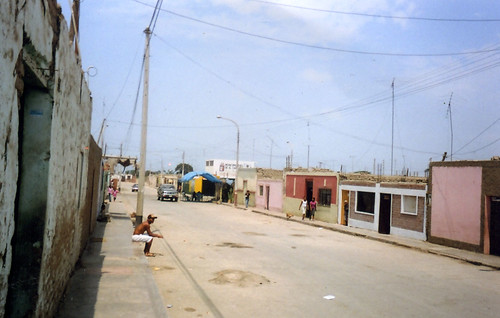
La Calle San José (St. Joseph Street) in El Carmen, Perú

Although, I have not been to Perú in the last couple of years due to my work situation, I stay in touch with my goddaughter Daniela, her family, and the family next door who gives me a place to stay during my visits. About a month ago, I contacted Daniela in El Carmen, Perú by phone and asked how many times she and her family and friends would like to go to the beach in that given month so I’ll know how much money to wire the van driver. She excitedly stated three times. 

I have so much love for Daniela that I try to do things, even while here in the USA, that I think will make her happy. However, I became very suspicious when I called Daniela again and asked her if she wanted to continue going to the beach. She responded yes, but asked that I  wire the money to her mother and not the van driver. She explained that the van driver will not be able to do it, and there was no I that I could talk to him. Daniela added that her mother will find another driver. Sending money directly to Daniela's mother for Daniela's entertainment was what I was trying to avoid. I want Daniela to enjoy her childhood, and not have her family members pocket that money to pay their dad-gum bills.

Last year, I told Daniela that I wanted to buy her another bicycle because the one I bought for her a year or two prior was sold by her family. Daniela was exhilarated by that offer. I got her uncle on the phone and explained that I was willing to pay him a fee if he took Daniela to the shop to buy her a bicycle. I emphatically told him “not” to sell it this time. It is strictly for Daniela's enjoyment. After wiring the money, I followed up with a phone call. Her grandmother got on the phone sounding excited, and assured me that Daniela was extremely happy.

However, when I finally got hold of Daniela, the excitement that she initially expressed was no longer there. She sounded very sad, and told me that she needed $100 for school supplies, Hmmmm—very strange. With my travel experience, I know how adults play games to fleece gringos. It’s just a shame that they would train an 11-year-old to be so dishonest. if my father ever caught me doing such a thing at that age (and he did!), that was an automatic “ass-whipping.” I have a sneaky suspicion that Daniela did not receive the bicycle. Just last week, I asked her if she would like me to buy her a bicycle. She said, “yes.” Then I immediately asked, “what happened to the one that I bought you.” She then realized, so it seemed, that she spilled her own beans, and insisted that it's in the house.

During my visits to Perú, I would always take care of Daniela personally. I bought her many gifts that she no longer has. What happened to them? I remember teaching her how to tell time when she was 7, then bought her a clock for her room. That clock immediately disappeared. Did her family sell all those gifts for cheap profits, or what? At one point, I was sending money directly to Daniela’s mother and grandmother with the understanding that the benefits of those funds will trickle down to Daniela. Maybe this is so, and maybe not. Meanwhile, I’m trying to think of creative ways to bring more joy to Daniela's life without people capitalizing on my generosity. Sooner or later, I will think of something!!!
           

Sunday, January 19, 2014

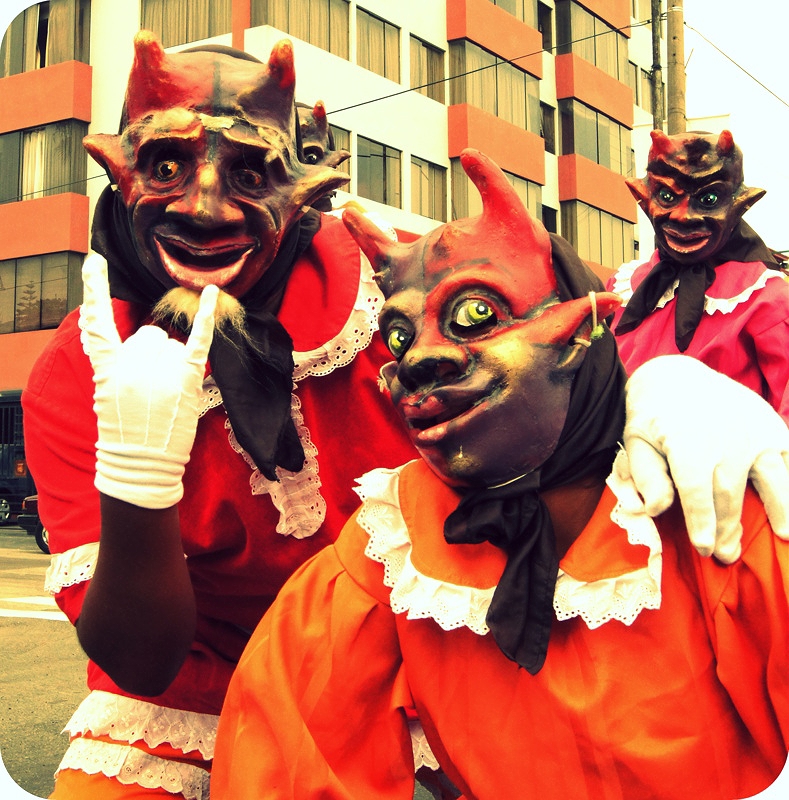
Son de los Diablos: Black Peruvian Rhythm of Devils


The Son de los Diablos (Rhythm of the Devils) is an Afro-Peruvian dance involving a mixture of African, Spanish, and Indigenous rhythms was banned from religious celebrations by the Catholic Church in 1817 because of its heavy African, and supposedly, devilish influence.

 Jawbones of donkeys, horses, and mules were 
used for rhythms of Afro-Peruvian music.
After the independence of Peru in 1821, the black folks lived in alleys near churches and plazas of Lima, the nation's capital, where festivities were held. Before the celebrations, blacks joined the festivities by forming gangs that danced the Son de los Diablos. Nonetheless, the dance remained an important part of carnival celebrations in Lima up until the early 20th century. The dance again was revived in the 1950s.

 
The Cajita (little box), an Afro-Peruvian percussion instrument

A distinguishing factor of the Son de los Diablos is its usage of such instruments as the Cajita, a small wooden box that opens and closes creating a distinctive sound, and the Quijada, the jawbone of a horse, donkey, or mule, that when hit creates a raspy buzz. Like other parts of the Americas that underwent a slave trade, the African drum was forbidden and the slaves had to get creative with their feet, and other makeshift instruments to continue their African rhythms.

Son de los Diablos performance by Perú Negro