Showing posts with label Afro-Peruvians. Show all posts

Wednesday, March 4, 2015

Kudos to Afro-Peruvian Doctor

 One of the main streets in Perú's predominately black District of El Carmen

I was so happy to just have called a friend in the predominately black town of El Carmen, Perú who used to help me with my Spanish, show me around town, and give me medical assistance when needed while in Perú. After all, he is a medical doctor.

 At a block party in the District of El Carmen

The irony is, I just learned that he is now working a full time, permanent job. No temporary, no on-call, nor anything of the like as he has done over the last three to four years taking whatever work he could get for whatever length of time just to get the valuable medical experience and make some much-needed money.


 An Afro-Peruvian dance class for youth

What is so interesting is that he lives in a predominately black town where their medical center has no black personnel. Everyone who works there is from outside the area. And here he is, a licensed physician, who could not get a full time job even in his hometown.

 Hanging out near the District's Plaza de Armas (main square)

I used to send him money from time to time while he was struggling financially to make ends meet. In fact, I used to pay him to converse with me in Spanish over the phone to help him out, and of course, improve my Spanish. Today, I felt good teasing and telling him that he needs to send me some money now that he is a full time, tenured physician. LOL. I am so happy for Dr. Milton Carrillo.


Thursday, March 20, 2014

The Afro-Peruvian Ghost Town and Museum

  Zaña, Lambayeque, Perú

Lambayeque District seeks to be recognized as a site of memory of slavery and African cultural heritage in Perú.as.Luis Roca, director of Cultural Heritage of Afro-Peruvian Museum of Zana said in August that the document presented to the people and then to the Ministry of Culture and the international organization concerned. "The record will be presented as part of the 450 years of Spanish foundation of Zana, the inauguration of the memorial of the freedom of slaves in Gallows Hill will develop, This initiative will place Zaña on the world map," Roca said.

Zana is the oldest city of Lambayeque, the minutes of Spanish foundation dates from 1563, a time when the first African slaves arrived; own cultural heritage as the Czech musical instrument and old churches. http://peru21.pe/actua.../zana-postulado-ante-unesco-2128246


Afro-Peruvian Museum, not to be confused 
with the one in Lima, the nation's capital

The town of Zaña in Peru’s province of Lambayeque, which I've heard in songs by Afro-Peruvian songstress Susana Baca, was once the nation’s capital. It used to be a thriving city with Spanish cathedrals, African slaves, estates, mansions, hulking chuches, and lots of gold. After being pillaged by British pirates in 1866, scaring away some of the wealthiest Spanish settlers and Mestizos, and then wiped out by a hurricane, the town has never been the same the same. 

The church and colonial officials blamed the slaves, whom they accused of bringing down the wrath of God with their African dancing and traditional religious practices. Today in this heterogenous village of about 1000 people has maintained its beauty. It is a town where you can climb over Spanish ruins feel a still-beating pulse that is distinctly an Afro-Peruvian rhythm. You can enjoy the music and dancing by locals at the Afro Peruvian museum, which is not to be confused with the National Afro-Peruvian museum in Lima that I personally visited in 2010, which focused solely on slavery. 

Camilo Ballumbrosio, master percussionist and dancer
explains the history of Afro-Peruvian music and dance

The museum also tells the story of the African cultures that live-on in Latin America today. Of particular interest is a room devoted to the musical instruments of Latin America‘s black population. Today, Zaña’s African descendants know their black heritage as it is passed down from generation to generation. Even the ones who may not look so African are quick to affirm that they are.

Zaña has also preserved its culinary legacy. The star dish is arroz con chancho (rice and roasted pork). The region has also adapted many Chinese dishes, due to the arrival of Chinese laborers in the late-nineteenth century. Zaña also enjoys local fame for its candies.

Sunday, January 19, 2014

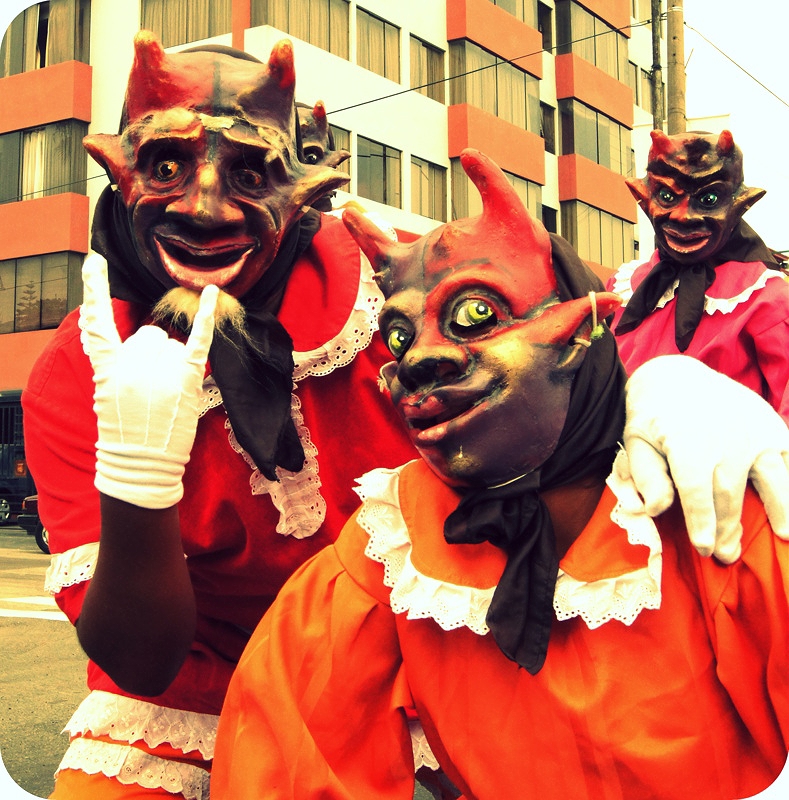
Son de los Diablos: Black Peruvian Rhythm of Devils


The Son de los Diablos (Rhythm of the Devils) is an Afro-Peruvian dance involving a mixture of African, Spanish, and Indigenous rhythms was banned from religious celebrations by the Catholic Church in 1817 because of its heavy African, and supposedly, devilish influence.

 Jawbones of donkeys, horses, and mules were 
used for rhythms of Afro-Peruvian music.
After the independence of Peru in 1821, the black folks lived in alleys near churches and plazas of Lima, the nation's capital, where festivities were held. Before the celebrations, blacks joined the festivities by forming gangs that danced the Son de los Diablos. Nonetheless, the dance remained an important part of carnival celebrations in Lima up until the early 20th century. The dance again was revived in the 1950s.

 
The Cajita (little box), an Afro-Peruvian percussion instrument

A distinguishing factor of the Son de los Diablos is its usage of such instruments as the Cajita, a small wooden box that opens and closes creating a distinctive sound, and the Quijada, the jawbone of a horse, donkey, or mule, that when hit creates a raspy buzz. Like other parts of the Americas that underwent a slave trade, the African drum was forbidden and the slaves had to get creative with their feet, and other makeshift instruments to continue their African rhythms.

Son de los Diablos performance by Perú Negro

Tuesday, December 17, 2013

My New Revelations on Black Perú


Until today, the focus of my Afro-Peruvian experience and observations has been on the province of Chincha in Southern Perú, dubbed as the hub of Afro-Peruvian culture. It is here, where every February, people from all over Perú, and different parts of the world, come in droves to party in celebration of black heritage, and it’s here where I myself have family-like connections and visit every chance I get. 

However, on a couple of occasions, I started receiving comments on my blog from Afro-Peruvians informing me that Chincha is not really the hub of black culture; that most of the black people live in Northern Perú. Most recently, an African-American currently living with his Afro-Peruvian wife in the northern town of Zaña confirmed this to be true. He explains that due to Chincha’s heavy influx of migrants from the Andes and resulting interracial marriages, the African presence is not as strong as before. And this is further exacerbated by the fact that many of Chincha’s blacks moved to major cities, like Lima, seeking better job opportunities. I have to admit that when I first arrived in Chincha, I hardly saw any black people. It wasn’t until I arrived in the District of El Carmen where I saw a heavy black population, and even El Carmen itself has a large population of Mestizos from the Andes.


The greatest Afro-Peruvian populations of the north coast are found mainly in the regions of Piura and Lambayeque where there are large rice fields and mango plantations. The colonial city of Zaña in Lambayeque, once the Peruvian capital, is famous for being the second most important Afro-Peruvian city in the north. It is here where you will find the Afro-Peruvian museum, not to be confused with the National Afro-Peruvian Museum in Lima.


Recently it has been verified that the community with the greatest concentration of Afro-Peruvians is Yapatera in Morropón (Piura), made up of around 7,000 farmers who are largely descended from African slaves of "Malagasy" (Madagascar) origin. They are referred to as "malgaches" or "mangaches".- See more at: http://travelerspress.com/visit-northern-peru/#sthash.mAlgItGq.dpuf

With my new African-American friend living in Zaña with his wife, and my love for Afro-Peruvian culture, Piura and Lambayeque are in Northern Perú are now on my itinerary the next time I enter Perú

Thursday, October 10, 2013

What, I'm an Angel Now? Words of an Afro-Peruvian

 
On two occasions, my friend, Milton, in El Carmen, Perú referred to me as an “angel” because on more than one occasion, I wired money to him and his mother for no other reason than the joy of giving to what I felt is a worthy cause. This is particularly out of my heartfelt love for the Spanish-speaking portion of the African diaspora. I’m also paying Milton, who speaks hardly any English, to help me perfect my Spanish through weekly one-hour conversations over the phone, which he very much appreciates because he can certainly use the money. I’m thankful that I’m fortunate enough to give and be in the position to travel, interact and learn from other cultures. To show my thanksgiving, I find ways to give back to those who show me the love and hospitality that I seek during my travels.

My thanksgiving could be in the form of dinners at restaurants (on me), gifts, or simply the wiring of occasional money through Western Union without breaking my own bank. Now, I’m wondering how many others have referred to me as an angel, as I have done the same thing in Cuba, Ecuador, El Salvador, Perú, and Venezuela. 

There is no credit needed or being sought here because there is a universal law that whatever you sow, you will reap. Whatever reward or recognition that I receive for my deeds, I prefer that they all come from the all-knowing, all-powerful, every-where-present, and abundant God.