Showing posts with label Perú. Show all posts

Saturday, November 30, 2013

My Issue With the World-Renoun Afro-Peruvian Singer Susana Baca

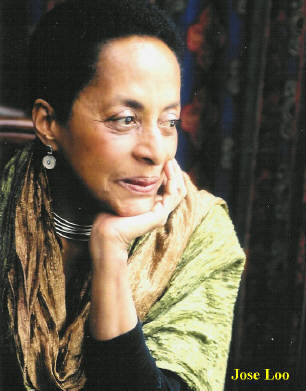
It was in 2010 when I posed a question about the world-class Afro-Peruvian singer Susana Baca in my blog post entitled, A Question about Susana Baca, who by the way, was the first Black cabinet minister of the Peruvian government.  

To me, she is the Spanish-speaking version of Billie Holiday or Bessie Smith with upbeat rhythm sections along with fluid dance moves as she combines Afro-Peruvian, Afro-Cuban, and jazz in her music.

As I stated in my prior blog article, I was on a natural high for six months, after seeing her perform for the first time in 1999. This experience inspired several future trips to Perú where I established solid Afro-Peruvian social connections.

With all that said, here is my issue with Susana Baca:

She travels the world singing about Perú's “African” culture, but seldom hires black Peruvian musicians in her five-to-six-piece bands. I've seen her perform on three occasions and saw only one black person in only one of those three performances. With black Peruvians suffering enough racial discrimination when it comes to jobs, why is she perpetuating it through Afro-Peruvian music? Several people responded to my blog article mostly in agreement with my concern. Others wanted to withhold any judgement until they get more facts on the matter.


Finally, after three years, I get to hear some facts from Timothy, an African-American friend living in Perú with his Afro-Peruvian wife. He says that the US visa system is partly to blame. He explains that it is tough for Afro-Peruvians to get a visa because many are below the poverty level, and that Susana has to redo her entourage for each country with visa restrictions. Timothy added that there have been issues with members of her band who paid $1000s for an entertainment visa to a foreign country and later defected. The visa requirements for the US alone is set far above the income levels of Afro-Peruvians. Some need to own property to assure that they have a reason to return to Perú.

Thursday, October 10, 2013

What, I'm an Angel Now? Words of an Afro-Peruvian

 
On two occasions, my friend, Milton, in El Carmen, Perú referred to me as an “angel” because on more than one occasion, I wired money to him and his mother for no other reason than the joy of giving to what I felt is a worthy cause. This is particularly out of my heartfelt love for the Spanish-speaking portion of the African diaspora. I’m also paying Milton, who speaks hardly any English, to help me perfect my Spanish through weekly one-hour conversations over the phone, which he very much appreciates because he can certainly use the money. I’m thankful that I’m fortunate enough to give and be in the position to travel, interact and learn from other cultures. To show my thanksgiving, I find ways to give back to those who show me the love and hospitality that I seek during my travels.

My thanksgiving could be in the form of dinners at restaurants (on me), gifts, or simply the wiring of occasional money through Western Union without breaking my own bank. Now, I’m wondering how many others have referred to me as an angel, as I have done the same thing in Cuba, Ecuador, El Salvador, Perú, and Venezuela. 

There is no credit needed or being sought here because there is a universal law that whatever you sow, you will reap. Whatever reward or recognition that I receive for my deeds, I prefer that they all come from the all-knowing, all-powerful, every-where-present, and abundant God.


Sunday, September 8, 2013

I'm Thinking of Retiring in Perú


The Main Square of El Carmen, Perú,
the hub of Afro-Peruvian culture

While chatting with Dr. Carrillo of El Carmen, Perú , an idea hit me like a ton of bricks, and that is to one day retire in Perú since I grew to love the country after so many trips. I have friends and family-like ties, and even a goddaughter there. Even better, however, is the low cost of living.  With a little frugality, I can live comfortably on half my retirement income, and save an invest the rest. After talking to some more of my Peruvian friends, I learned that I can rent a two-bedroom apartment in a nice, safe neighborhood in the capital city of Lima for as little as $300 per month, and in the District of El Carmen, where my goddaughter lives, we are talking about less than $100. According to Dr. Carrillo, I can have a brick home built from the ground up for under 10K, and can hire a housekeeper/cook, and a security guard, and pool my money with members of the community to buy food wholesale. I can even make extra money teaching English - a marketable profession in Perú, I even thought of conducting Afro Peruvian tours and doing hospitality for English speaking visitors as well as rent one of my rooms to tourists. Millions of ideas are flowing through my head right now.


I'm standing in the back (second from the right) 
with El Carmen's famous Ballumbrosio Family

Nothing has been decided as of yet as I will be in the exploration and  fact-finding stage for quite some time. I’m exploring the red tape involved such as medical insurance, immigration procedures, and other factors to see if it is all worth it. Will I get bored for things I've taken for granted in the USA? How will deal with Latin-American time? We African-Americans call it Colored People's Time (or CPT) where we are stereotypically late. It was brought to my attention that in Latin America it is not considered polite to arrive on time when you are invited to an event. Interesting! Who knows, I may be in for another culture shock greater than what I experienced when I moved from New York to California. Can I adjust? 


 My goddaughter Daniela, of El Carmen 
celebrating her 11th Birthday

A friend of mine expressed a concern that once I become a resident that I will be facing the same type of racism that Afro-Peruvians face and no longer be treated as a guest in their country. My opinion is that just as in the USA, foreign blacks are perceived as less of a threat than the native blacks, I too will be perceive differently in Perú with my foreign accent and American passport. In my first visit to Perú in 2005, I approached two cops in their patrol car seeking directions. Both seemed frightened and suspicious of me, but as soon as they heard talking “funny” expressing my desire to find a place to exchange my money into Peruvian currency, they immediately became jovial and friendly as they gave me the directions I needed. Wow, that was interesting! I do plan on supporting the Afro-Peruvian civil rights struggle once I get settled. There are three civil rights organizations that I know of already.

Cesar y Maribel
Peruvians in “the Hood”

One thing that I have in common with Peruvians, especially in the coastal region is my love for salsa and Cuban music. In the predominately black District of El Carmen, an ipod is the last thing I need because they be jammin’ on some Cuban music that will make you dance in your sleep. But I also enjoy classical music, and Lima has a symphony orchestra. There are some jazz clubs in Lima as well, but for R&B, I will have to depend on iTunes. It seems as though when it comes to getting all of my personal and cultural needs met, I may have to live in Lima and spend three-day weekends in El Carmen, or vice versa, while taking occasional vacations to the US and other countries. Right now, this is all speculation, and I have plenty of time to think about it..

Monday, June 3, 2013

June 4 - Afro-Peruvian Culture Day

Nicomedes Santa Cruz 
1925-1992

In October of 2005, I made my first, but certainly not my last, trip to Perú primarily to connect with Afro-Peruvian culture. As a music lover, I was attracted to Perú by a CD entitled The Soul of Black Perú. The CD features leading Afro-Peruvian artists such as the prolific writer, musician, poet, and Black cultural icon Nicomedas Santa Cruz.  Thus, the date of June 4, Santa Cruz's birthday,  was chosen as Afro-Peruvian Culture Day in his honor, and this celebration will carry on for the rest of the month. Perú has several Black heritage events throughout the year, such as Verano Negro, Santa Efigenia,  and Yunga. 
  
 Mamainé, Peruvian soul food restaurant 
in Perú's District of El Carmen.


According to unofficial estimates, Perú's Black population makes up 10%-15% if you count the one-drop of Black blood rule that is applied here in the US. The majority of Afro-Peruvians live in the nation's capital of Lima and in the port city of Callao but there are also large communities in the Northern and Southern regions as well, especially in the area known as Yungas where the plains meet the Andes.


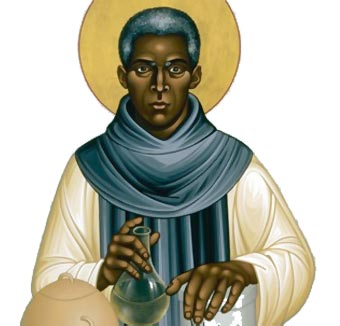
St. Martin de Porres, noted for his tireless work on behalf of the poor. A district in Lima is named in his honor.

The first Africans arrived in Perú with the conquistadors in 1521 serving as soldiers, personal servants, and body guards. Later, when African slaves arrived in the urban areas of Perú, they served as cooks, laundry persons, maids, handymen, and gardeners.  Cañete, Perú, just South of Lima, and Chincha, Perú, about three hours South of Lima, are where a large portion of African slaves were brought to work the cotton fields and other plantations. Both Cañete and Chincha are recognized as the hub of Afro-Peruvian music and dance. However, due to a heavy influx of indigenous people migrating from the Andean areas, and so many Blacks leaving for the bigger cities in search of jobs, the Blacks in Cañete and Chincha are no longer the majority. When I pass through Cañete, I don't see any Blacks at all as they are concentrated in Cañete's District of San Luis. In Chincha, I don't see a large concentration of Blacks until I get to the District of El Carmen, where I stay with Perú's famous Ballumbrosio family.


I am in the back, second from the right with the family of the late, great maestro, Amador Ballumbrosio, the godfather of Afro-Peruvian music and dance.

As in every nation that was involved in the slave trade, an important part of Perú's history and heritage have been built with the efforts of Black people who have influenced and contributed heavily to Peruvian culture and identity, especially in music, food, athletics, dance, arts, science, and religion.


 Teófilo Cubillas
Perú's all-time leading scorer in soccer 


Mauro Mina
The “Chincha Bomber” - Former South American Light-Heavyweight Champion, ranked #1 in the world by Ring Magazine.
 
 
Lucila Campos, one of the original members of the world's famous dance troupe, Perú Negro (Black Peru) also became a solo artist of Afro-Peruvian music.


Ronaldo Campos de la Colina
Founder of world's famous Perú Negro (Black Peru) dance troupe 


Sunday, March 24, 2013

They Are Trying to Be So Slick!

 My goddaughter Daniela and me in El Carmen, Perú

A Peruvian friend of mine living here in Oakland warned that me one day that people in Perú will try to use my goddaughter Daniela, who lives in Peru, to get more money out of me because they know I have a soft spot for her. Being a seasoned traveler, I was not surprised and I only knew it would be matter of time before some jerk tries it. Sure enough, it happened. I recently wired money to Daniela's uncle to buy her another bicycle as her first one was broken and sold to someone who can fix it. I paid him some money in exchange for doing me that favor. Daniela was such a happy camper I was happy for her. Especially when the family next door, who gives me a room to stay when I'm in Perú, sent me a picture of her on her new bicycle.


I called a few days later to see how she liked it, and that's when Daniela told me that she needed $150 worth of school supplies (in February). I asked her describe exactly what she needed, and it was the usual, a notebook, pencils, erasers, and things that don't cost any more than $10. I knew that this request was not Daniela's idea. In fact, I can hear the concern in her voice that she was not comfortable lying to me. Someone is trying to be slick. I've wired money to Daniela's family frequently in the past without their ever asking for a dime. It's saddening that a 10-year-old is being taught by so-called role models to be so dishonest. Very sad! I can only pray that this does not corrupt her as she reaches maturity.


Thursday, March 7, 2013

Strong, Gifted, Black Peruvian Woman


Mónica Carrillo Zegarra

With the month of March being Women's History Month, and with all of my trips  to Perú and explorations into Black Peruvian history and culture, I think of several women whom I admire and respect:

  1. Adelina Ballumbrosio, wife of the late great Amador Ballumbrosio, the godfather of Afro-Peruvian music and dance who always gives me food and a place to stay every time I'm in Perú. 
  2. Victoria Santa Cruz, composer, choreographer and daughter of the greatest exponent of Afro-Peruvian culture Nicomedes Santa Cruz.
  3. Susana Baca, the internationally acclaimed singer of Afro-Peruvian music who is also Perú's Minister of Culture.

However, the woman I want to highlight will certainly go down in history as one of Perú's greatest civil rights leaders as her work, while still in her 30s, has given her international recognition. She is Monica “Oru” Carrillo, who has become a role model and an advocate working to empower Perú's Black community, particularly the young, and is striving for Perú's rich African heritage to be included as part of the Peruvian national identity. I first learned of Monica from watching the Documentary Series, Black in Latin America, which was aired on PBS. 

Oru, as she is also known, is the leader of Lundú. The name, Lundú, originates from a traditional African dance in the Kongo region of Western Africa, which means “successor.”  This organization helps young Afro-Peruvians overcome racism and sexism using the arts, advocacy, education, civic engagement, and economic and educational opportunities. It's outreach to black youth involves life skills, sexual education, black pride workshops, and empowerment against violence, abuse, forced sex, and unwanted pregnancies. I personally have a10-year-old goddaughter in Perú, and often try to  say and do things to contribute to her self esteem. I've been trying to get her involved in Lundú because the girls who are involved have developed a healthy dose of self esteem, which is one of the greatest gifts anyone can receive.
 
Monica's parents are from El Carmen in Chincha, Perú, which is the hub of Afro-Peruvian culture. She grew up living a hard life in Lima, the nation's capital, and being Afro-Peruvian of female persuasion, made life even harder. She was only 11 years old when her and her sister, age 12,  were riding a bus when someone spit on them shouting, Negras conchetumadre (f... you nig...). No one on the bus attempted to defend those children, and no offered to help them get cleaned up. As an adult she spoke of a day when she left her house and counted12 insults that she received in just 20 minutes. The people who make these insults, she says, don't run away because they feel that they are in the right. It's machísimo thing.

Instead of her breaking down and letting her self worth deteriorate, she grew into an activist, feminist, college graduate, having also studied at Oxford. She is a hip-hop artist, writer, poet, singer, musician, journalist, and educator. She mixes poetry, Afro-beat, soul, hip-hop, and Afro Peruvian music to highlight contributions made by black Peruvians to combat racism and sexism. Her music has been featured internationally, particularly on Europe's MTV.

I was so thrilled when Moncia, whom I've been in communication with on social media for two years, called me from 148th Street and St. Nicholas Avenue in Harlem, NY, just three blocks from where I lived when I was in the second and third grades. She was visiting Harlem to do a presentation at the Arturo Alfonso Schomburg Center for Research and Black Culture, which is right across the street from where I went to elementary school. She and I plan to meet in person upon my return to Perú later this year. 

I won't say to you Happy Women's History Month, because in reality, Women's History Month is every month!