Showing posts with label Cuba. Show all posts

Tuesday, May 31, 2016

Afro-Cuban Twin Sisters Profit from Cuban Cigars


So many people are taken aback to learn that a increasingly popular Cuban cigar brand is owned by two young Afro-Cuban woman in an industry dominated by older white Cuban males.

Although fluent in Spanish as well as English growing up in a Miami community heavily populated by white Cubans, they were taught to be black and proud by their grandmother, and became bi-cultural as they embraced African-American culture as well as their own Cuban culture interacting and weaving comfortably well in both Latino and African-American communities.  

An ongoing surprise to me is the number of Latinos who seem to be so unaware that there are black folks in their community who, like they themselves, have Spanish-speaking roots. Cubans, of all Latinos, should know better considering that their home country  has an overwhelmingly black population.


Original article:

MIAMI, FL -- When Afro-Cuban-American twin sisters Yvette and Yvonne Rodriguez launched their Tres Lindas Cubanas cigar line last year, they wanted it to represent some of the diverse Cuban races as well as honor their grandmother, who inculcated them with pride in their African roots.
On a recent afternoon in a Coral Gables cigar shop, the twins point out their three signature cigars: "La clarita" - which means fair-skinned - and is light-medium bodied; "la mulata," which means mixed black/white as is medium-full, much like their grandmother; and "la negrita" means black which is their strongest, full-bodied cigar.


Coming from a mixed race family, the twins were somewhat confused when they were growing up in Miami, where the Cuban population is predominantly white. Their mother, a Cuban mulata, and father, a black Cuban, settled in the Miami suburb of Cutler Ridge, which had a mix of races.
"We were Cuban, we were black, and the kids did not understand that," Yvonne said. When their light-skinned grandmother would pick up the twins and their brother from school, students were puzzled to see her fair complexion. "Kids would ask 'who's that?' This light-skinned woman picking up three little black kids," Yvonne said. They recall bus rides home from middle school telling students about their ancestry.

The witty and lighthearted twins speak with adoration of their maternal grandmother and admit they were also confused growing up. "She was a mulata of mixed race but she came out very light skinned," Yevette explained.

Their grandmother emphasized the importance of being proud of being black. When people complimented her for being elegant, she would respond 'an elegant mulata.' Yvette explained "it was weird for us because for me she was just a white woman … she was a white woman saying 'nosotros las negras'[us black women]," they said laughing.

Although their complexion was confusing for them when they were 10 years or 12 years old, when they were a bit older they realized they were comfortable around Latinos as much as they were among African-Americans and weaved comfortably in and out of both communities.
"We could jam out to hip hop or R&B and speak Spanish a few seconds later. We are very in tune with both cultures," Yvonne said.


It was through classic music, food, and stories that Yvette and Yvonne learned about their Cuban culture. "Back then the embargo was real and there was no Internet," Yvonne explained. Their parents were traditional, conservative, and Republican. But growing up in the U.S. they embraced African-American culture in addition to their Cuban culture and found their own identity.
"We don't fit the mold people are accustomed to seeing," Yvonne said.
These variations are the essence of the cigar line, which they say has created a dialogue for those who are confused like they once were.

Monday, January 18, 2016

Cuban Celebration of Martin Luther King


Centro Memorial Martin Luther King, Jr. in Havana, Cuba

During my visit to Havana, Cuba years back, I was pleasantly surprised to learn about the MLK Center in the city's Mariano District. During the civil rights movement on which Martin Luther King, Jr., was at center focus, Cuban church leaders, especially those who led congregations with members of African descent, were inspired as the desire for justice, equality and reconciliation was sweeping the world.


In 1984, under the leadership of the Rev. Raul Suarez, the Cuban Council of Churches invited delegations of leaders from African American churches and Historic Peace Churches to visit Cuban denominations. This delegation was successful in opening up dialogue between church and state. The Rev. Jesse Jackson, who led one of the delegations, arranged for a meeting with President Fidel Castro who determined that these church leaders support the social goals of the Cuban Revolution, but on moral grounds, and promised to work for new religious freedoms and opportunities for the churches of Cuba.


Members try to contribute to community development and, which dares to transform itself and the world and which reaffirms love, compassion, respect for diversity, justice, gender equality and the integrity of all human beings. It has helped people in low-income areas to build housing. The center also has helped to build bridges between people in Cuba and the United States, whose governments broke off relations more than 50 years ago.

Saturday, January 31, 2015

My US Afro-Cuban Connections

Oakland, California

Being a lover of music from Cuba, along with a strong desire to use my Spanish made me want to be closer to the fairly large Afro-Cuban community in Oakland where I spent most of my adult life before returning to hometown of New York. This was especially true after my two week trip to Cuba where I was deeply touched by the culture and the hospitable nature of Cuban people.

My professional connections with Afro Cubans in the U.S. was a result of my work as an employment counselor as I started meeting a large wave of immigrants called balseros (Spanish for rafters) because they escaped the Island of Cuba on makeshift rafts. 

One such balsero was Miguel who invited me to a party so I could meet his family. We used to have long conversations in my office as he enlightened me on the things I observed during my Cuban visit. There was also Jesús, a very outgoing Cuban musician whom I interviewed for a salsa music magazine where I served as a part-time staff writer.
.
My social connections with the Afro-Cuban community is different and surprisingly limited due to, unfortunately, the cultural comfort zone of the average Cuban immigrant who naturally wanted to be around other Cuban immigrants or Latin Americans. I had a much easier time mingling with Cuban men and women on the island of Cuba.

One exception was Vladimir, another balsero, whom I met at the Caribee Dance Center in Oakland where we hung out on salsa nights. Due to our frequent patronage of the center, our rapport grew. It was about this time when I was planning my trip to Cuba, and Vladimir was good enough to hook me up with his family in Havana where I was welcomed like a member of the family and well fed with Cuban food.

One year after my trip to Cuba, Vladimir's mother, Julia, came to Oakland to be with her son for one year. I used to stop by the house often to keep Julia company in my appreciation of the family-like way she and her family treated me during my Cuban visit. What was strange was that Vladimir spent a lot of time away from the home doing his thing. That would have never happened in Cuba. 

One evening, I just happened to be coming home late from work and found Julia stranded outside of Vladimir's apartment. She was locked out, and she had no idea of the whereabouts of her son. To help Julia, I managed to climb into the first-floor apartment through a side window, and provided Julia her needed access.

After Vladimir's mother Julia returned to Cuba, Vladimir soon moved out of the neighborhood without even telling me. He never even called me with his new contact information or anything. I interpreted that as a break in our friendship, which abruptly ended any rapport that I had with the Afro-Cuban community in Oakland.

It was a Saturday afternoon in nearby Berkeley, CA when I was browsing a Flea Market proudly wearing my Cuban baseball cap. I just happened to pass a stall run by Afro-Cubans selling video and stereo equipment. They were strictly business and not too friendly even though I spoke Spanish and expressed genuine appreciation for the loud Cuban music they were playing in the background. 

One of them gave me a hard, curious look before reluctantly asking, ¿Cubano? (Are you Cuban?). As I tried to explain in Spanish that I visited the island, he simply turned his back and walked away while the owner stated with a smirk on his face, “¡él no es Cubano (dude ain't Cuban)!” I just laughed and moved on to get away from the not-so-welcoming cliquish vibes.


I don't meet too many black Cuban woman in the US, and I'm guessing because not too many of them take the risks of crossing the Gulf of Mexico on makeshift rafts. However, when I was in Cuba, I was drooling over all the attractive black women I could choose from if I lived on the island because so many Afro-Cuban guys seemed to be attracted to white and mestizo women.

Finally, there was Lydia, an Afro-Cuban woman who hated on me for a long time because she felt that my love for the island of Cuba and its music was making me swing to the beat of Castro, a man whom she and many Cuban refugees despise with a passion. Lydia and I used to verbally cut each other up in English and Spanish.

One day, while in one of her civil moods, she turned me on to a book entitled “Hijack” written by Tony Bryant, a former Black Panther who hijacked a plane to Cuba. Tony wrote about how his experience in Cuba converted him from a leftist black revolutionary into a right-wing republican by the time he returned to the USA 14 years later. When I expressed an interest in reading this book (a good read, by the way), she immediately felt love for me as a brother.


Friday, October 17, 2014

Cuba's Love and Respect for American People


One of the most joyful moments in my life was entering the José Martí Airport in Havana after off-boarding Aero Cubana airline.


Some years back, a group of us American students had the opportunity to attend the University of Havana for Spanish-language intensive training. We went legally through the San Francisco-based Global Exchange, Inc., an international human rights organization. We flew to Cancún, spent the night, and at noon the next day, we caught our 45-minute flight to Havana where  Cuban hosts welcomed us.


If you talk to just about anyone who traveled to Cuba, they will tell you how much the common, everyday Cuban citizen love and respect American people despite the long-standing conflicts between US and Cuban governments. 

 Cultural exchange between Americans and Cubans

As I made my way around Havana, people assumed that I too was Cuban until they heard my foreign accent (in Spanish), and asked where I'm from. When I told them the USA, they generally shook my hand saying, “nice to meet you.” I've been invited to people's homes for dinners, shown the town, and introduced to new friends while dancing salsa.

I felt so out of place wearing my University of Havana and other Cuban t-shirts that I bought as souvenirs because they were dead giveaways that I'm a tourist. T-shirts with English writing on them donated by American and Canadian visitors over the years are hot items to be attained among Cuban people. I saw a woman wearing a New York Knicks jersey, and out of excitement, I shouted in Spanish, “that's my team! She gave me a confused look because she did not know what she was wearing. The fact that it was in English made it a fashion statement, and that was all that mattered. 

 Attending a lecture on Cuban Culture on 
the porch of the Che Guevarra house.

If you think the US economy is bad, you should see Cuba's where basic things we take for granted are in short supply and rationed out. It's not uncommon for people to wait an hour or two on a long line to buy a loaf of bread, for example, only to find that it is sold out. The US trade embargo against Cuba that has been going on for more than half a century has a lot to do with Cuba's economic woes. And it's not the Cuban government who is suffering nearly as much as innocent men, women, and children who feel no animosity whatsoever against American people.

If you have a chance to visit Cuba be it legally or through other available means, it's a good idea to take some items that you don't need and give them to the people with whom you establish rapport. Items such as CDs, T-shirts, clothing, toothbrushes, soap, and USB flash-drives would be greatly appreciated. When I gave a seven-year-old boy a set of pens and writing paper, he high-fived me with such excitement that you would think I gave him a $20 bill. 

One of my salsa music dance partners in 
the Barrio Habana Vieja (Community of Old Havana)


Havana, like every big city, has its share of city slickers who find legal ways hustle the increasing number of tourists. A bicycle-taxi driver supposedly invited me to a party for one of his little nieces. He and his friends were to lure me into the home and have me buy all the liquor and the food so they (and I) will have a good time. The hosts at the Che Guevarra house, next door to where I was staying, pulled my coat-tail to the scheme.

The crime rate is very low in Cuba because the penalties are so harsh that would be criminals are not willing to take the chance. What would get you a slap on the wrist for a first offense in the US can easily get you ten, or more years in a Cuban prison. There are secret police who keep a close watch on their citizens and surreptitiously report the slightest infractions to the authorities. They also identify and keep watch on visitors making sure they stay safe. This is all to build their growing and lucrative tourist industry. I remember how one aggressive person approached me, and I said to him, ¡no me moleste (don't bother me)! He immediately backed off, not because he was afraid of me; he was afraid of who was watching me.

While so many Cubans admire American culture, people around the world love Cuban culture, especially the music. Cuban music, food, and the Afro-Cuban religion, Santería, are international attractions. I just hope when this political conflict between the Washington and Havana governments are finally over that the Cuban culture continues to flourish.

Monday, July 1, 2013

Havana City


These days, I have to be careful how I list my studies at the University of Havana in Cuba on my résumé because people tend to think I sneaked into Cuba illegally, and never bother to ask how I was able to enter legally.. I traveled to Cuba through the Global Exchange program, which has a license from the U.S. government to sponsor trips that are educationally and culturally focused. At that time, Global Exchange had a partnership with the University of Havana where Americans can learn and develop their Spanish-speaking skills through total immersion in that the instructors, tutors, and host families speak Spanish only. ....

Being the salsa music lover that I am, I was excited about not only improving my Spanish, but improving my salsa dancing skills as well. In my travels to more than 150 cities in 14 countries, I've never felt so much at home as I did in Havana. It was pure joy to just walk down the street hearing son-montuno music, charanga music, danzon, and timba music blaring from cars, homes, and businesses. One afternoon, there was a group of us walking through Central Havana where we heard this loud salsa song coming out of a restaurant. I grabbed one of the women in our group and we danced right there in public.


The beauty of this trip was that I stayed with a family in the middle of a community where there are hardly any tourists. It was amazing how so many people in the community looked at me and assumed that I was just another Cuban until I opened my mouth. My foreign accent was a dead give-away. I did make some fine friends with people who went out of their way to make me feel like one of them. One was Denalys Fuentes, a cute, petite Afro-Cuban woman who was my salsa dance partner as we went to party at the Palacio de la Salsa (Salsa Palace), a major Havana night club. She and I continued to write each other after my return to the US.

In a city of over two million, I found the Habaneros (Havana City people) to be so pleasant, neighborly; and highly approachable. You don't feel that sense of paranoia and fear when you stop people and ask for directions like here in US cities. It's probably because Havana is a much safer city than "any" mid to large city in the USA, mainly because punishment for crimes are a lot stricter in Cuba, and the potential criminal, more often than not, will think thrice before committing any crimes. The street hustlers, called jineteros (hee-neh-tay-roes), will befriend you and coerce you into spending your money on them. For me, this was an amusing opportunity to practice my Spanish.


Any animosity between Cuban people and the United States lies solely with the two governments, not the people. The average Cuban citizen I met admire American people and American culture. They love it when American visitors bring t-shirts, CDs, and other American-style items they no longer need to give away. In fact, I didn't want to wear any of my Cuban t-shirts that I bought as souvenirs because that would have been another dead giveaway of my being a foreigner. I simply waited until I make it back to Oakland.


Side note: I'd be remiss not to mention the thousands upon thousands of Cubans who fled Cuba and are scattered not only throughout the US but in Europe and Latin America. These Cuban refugees who sought asylum in other countries lived and experienced a Cuba that visitors like myself do not get to see or experience.

Monday, May 20, 2013

For Blacks in Cuba, The Revolution Hasn't Begun


I had the opportunity to visit Cuba (legally) back in 1998 to take a Spanish-language intensive course at the University of Havana, but was not there long enough to notice the apartheid type policies that were in place because I was protected by my US passport and dollars. At that time, US currency coveted by Cuban businesses for circulation. We foreigners from everywhere were having the time of our lives, totally oblivious of so many naturalized Cuban citizens risking their lives to escape and seek asylum in places, like the US, Spain, Mexico, and Perú.

My Afro-Cuban neighbor here in Oakland, CA, connected me with his family in Havana, but never explained to me why he himself faced the perils of the waters to escape Cuba on top of an inner tube of a tire. None of his friends whom I also befriended ever complained or reprimanded me for visiting Cuba, like so many other Cuban refugees who left Cuba long before them.


--W Bill Smith


By Roberto Zurbano, editor and publisher of La Casa de las Américas (House of the Americas) publishing house. This essay was translated by Kristina Cordero from the Spanish.

CHANGE is the latest news to come out of Cuba, though for Afro-Cubans like myself, this is more dream than reality. Over the last decade, scores of ridiculous prohibitions for Cubans living on the island have been eliminated, among them sleeping at a hotel, buying a cellphone, selling a house or car and traveling abroad. These gestures have been celebrated as signs of openness and reform, though they are really nothing more than efforts to make life more normal. And the reality is that in Cuba, your experience of these changes depends on your skin color. 

The private sector in Cuba now enjoys a certain degree of economic liberation, but blacks are not well positioned to take advantage of it. We inherited more than three centuries of slavery during the Spanish colonial era. Racial exclusion continued after Cuba became independent in 1902, and a half century of revolution since 1959 has been unable to overcome it. 

In the early 1990s, after the cold war ended, Fidel Castro embarked on economic reforms that his brother and successor, Raúl, continues to pursue. Cuba had lost its greatest benefactor, the Soviet Union, and plunged into a deep recession that came to be known as the “Special Period.” There were frequent blackouts. Public transportation hardly functioned. Food was scarce. To stem unrest, the government ordered the economy split into two sectors: one for private businesses and foreign-oriented enterprises, which were essentially permitted to trade in United States dollars, and the other, the continuation of the old socialist order, built on government jobs that pay an average of $20 a month. 

It’s true that Cubans still have a strong safety net: most do not pay rent, and education and health care are free. But the economic divergence created two contrasting realities that persist today. The first is that of white Cubans, who have leveraged their resources to enter the new market-driven economy and reap the benefits of a supposedly more open socialism. The other reality is that of the black plurality, which witnessed the demise of the socialist utopia from the island’s least comfortable quarters. 

Most remittances from abroad — mainly the Miami area, the nerve center of the mostly white exile community — go to white Cubans. They tend to live in more upscale houses, which can easily be converted into restaurants or bed-and-breakfasts — the most common kind of private business in Cuba. Black Cubans have less property and money, and also have to contend with pervasive racism. Not long ago it was common for hotel managers, for example, to hire only white staff members, so as not to offend the supposed sensibilities of their European clientele. 

That type of blatant racism has become less socially acceptable, but blacks are still woefully underrepresented in tourism — probably the economy’s most lucrative sector — and are far less likely than whites to own their own businesses. Raúl Castro has recognized the persistence of racism and has been successful in some areas (there are more black teachers and representatives in the National Assembly), but much remains to be done to address the structural inequality and racial prejudice that continue to exclude Afro-Cubans from the benefits of liberalization. 

Racism in Cuba has been concealed and reinforced in part because it isn’t talked about. The government hasn’t allowed racial prejudice to be debated or confronted politically or culturally, often pretending instead as though it didn’t exist. Before 1990, black Cubans suffered a paralysis of economic mobility while, paradoxically, the government decreed the end of racism in speeches and publications. To question the extent of racial progress was tantamount to a counterrevolutionary act. This made it almost impossible to point out the obvious: racism is alive and well. 

If the 1960s, the first decade after the revolution, signified opportunity for all, the decades that followed demonstrated that not everyone was able to have access to and benefit from those opportunities. It’s true that the 1980s produced a generation of black professionals, like doctors and teachers, but these gains were diminished in the 1990s as blacks were excluded from lucrative sectors like hospitality. Now in the 21st century, it has become all too apparent that the black population is underrepresented at universities and in spheres of economic and political power, and overrepresented in the underground economy, in the criminal sphere and in marginal neighborhoods. 

Raúl Castro has announced that he will step down from the presidency in 2018. It is my hope that by then, the antiracist movement in Cuba will have grown, both legally and logistically, so that it might bring about solutions that have for so long been promised, and awaited, by black Cubans. 

An important first step would be to finally get an accurate official count of Afro-Cubans. The black population in Cuba is far larger than the spurious numbers of the most recent censuses. The number of blacks on the street undermines, in the most obvious way, the numerical fraud that puts us at less than one-fifth of the population. Many people forget that in Cuba, a drop of white blood can — if only on paper — make a mestizo, or white person, out of someone who in social reality falls into neither of those categories. Here, the nuances governing skin color are a tragicomedy that hides longstanding racial conflicts. 

The end of the Castros’ rule will mean an end to an era in Cuban politics. It is unrealistic to hope for a black president, given the insufficient racial consciousness on the island. But by the time Raúl Castro leaves office, Cuba will be a very different place. We can only hope that women, blacks and young people will be able to help guide the nation toward greater equality of opportunity and the achievement of full citizenship for Cubans of all colors.

Wednesday, October 17, 2012

Havana City Slickers


I grew up in New York City, so I know a hustler when I see one. I don't care if I'm in Tokyo, Montreal, or Havana; a hustler is a hustler, and they give off the same vibes that is instantly recognizable--usually!. At the time of my Havana visit, I only brought $250 worth of spending money to last me two weeks. This was money for souvenirs, dating, and entertainment. Although, I was successful stretching my money to last a couple of weeks, I only had $10 in my pocket when I arrived at Havana's José Martí International airport heading back to Mexico City, before catching my flight back to Oakland, where I now live. Because Cuba does not recognize American banks, I could not use a credit card or an ATM until I arrived in Mexico.

Many of the Havana hustlers, or jineteros (pronounced Hee-neh-teh-rohs), as they are called in Cuba, are Black like me. However, they viewed me as a rich tourist first and a Black man second. All I could do was play with their minds when they approached me with their little games. I even got to the point where every time a jinetero would approach me, I would say something like, ¿qúe bolá? ¡Quiero ser jinetero como tú, asere! (what's up, I want to be a hustler like you, man).  They would always give me a nice little chuckle and move on.

The most interesting case of my being hustled, and not knowing it was when I hired Ernesto, a Black bicycle-taxi driver with whom I began to establish rapport and get advice on things to do about town. I'd arrange for him to pick me up at certain places at certain times. One day, as he was taking me to my Spanish language intensive class at the University of Havana, he told me that this Wednesday night, there was going to be a birthday party for his little niece. He also told me that he wanted to introduce me to a nice woman. He even introduced me to someone whom he claimed to be his brother, and his brother looked at me as though I were a gold mine; a Black gold mine, thus easier pickings.

Wednesday evening came around, and I forgot all about this little party as I was with Luisa, an attractive woman whom I met the first day I arrived in Havana. As Luisa and I returned from a local restaurant, heading back to her house, we ran into Ernesto who had just stopped by the place where I was staying. He was visibly annoyed. His so-called brother was in the car with a group of other guys driven by one of Ernesto's friends. It certainly looked like a set-up. They wanted to party hearty with plenty of food and liquor at my expense.

When I returned to the place I was staying, which was across the street from Luisa's apartment complex, I was told by several house-hosts that it is very unusual for anyone in Cuba to have a party for a child on a Wednesday night, and they vehemently warned me about fooling around with jineteros, people who hustle foreigners, most of whom have regular jobs, white and blue collar, and moonlight hustling tourists. This is big business in Havana

Tuesday, July 31, 2012

The Friendly US/Cuba Relations


Any animosity between Cuban people and the United States lie solely with the two governments, not the ordinary, everyday people; at least not with Cubans.

When I visited Cuba, I never noticed any animosity from Cuban people when they realized I'm American. I remember people practicing their English with me, or simply shaking my hand saying, “nice to meet you!” In the worse case scenario, some would try to hustle me and get me to spend my money on them, considering their abysmal economy in relation to ours. This ridiculous trade embargo against Cuba only makes matters worse; not for the Castro government, but for every day people, including children who have no beef with the U.S.
Any animosity between Cuban people and the United States lies solely with the two governments.. Cubans love it when American visitors come to get to know their country, spend their money, and bring their t-shirts, CDs, and other American-style items they no longer need to give away. I was sorry that I didn’t bring more things to give away. A professional dancer gave me a free private salsa lesson because I gave him a jazz CD. The seven-year old child of a woman I developed a rapport with, high-fived me as though I gave him a $20 bill when I gave him a package of pencils, pens, and writing paper.
Almost everyone in this Spanish-speaking city of Havana wore English-speaking t-shirts like it’s a fad. I remember meeting a woman on the malecón (the waterfront) wearing a New York Knicks jersey, and I shouted to her in Spanish, HEY, THAT'S MY TEAM :-) She looked at me bewildered as it turned out that she did not know what she was wearing. I just hope that when this political riff-raff is over between the US and Cuban governments, that Cuban people do not become too Americanized. The island has much to offer in terms of culture, which attracts people, like me, from all over the world.

Saturday, July 28, 2012

Cuba Converted Black Panther into a Patriotic American


 Afro Latino     black Latino     Cuba
 When I visited Cuba, it was not long enough to see what the real Cuba was like, and on my way back to the airport, I felt heart broken to leave so soon. I used to be in love with the island and was an admirer of Fidel Castro. The primary reason was while other Latin-American leaders sweep the racism in their countries under the rug, Castro spoke out against it, and made changes where blacks had educational and professional opportunities traditionally reserved for whites.

I felt so much at home on the island, considering my love for the diversity of its music that I felt tempted to defect and spend the rest of my life there. I thought Cuban refugees to the USA were overwhelmingly upper-class and had to leave Cuba to maintain their high standards of living and oppress the less fortunate like they did back home.

Upon my return to the US, I experienced hostilities from Cuban-Americans who felt I was supporting the Castro regime. One was a black women named Lydia Limeón who lashed out bitterly. After calming down, she recommended a book entitled Hijack by former Black Panther Tony Bryant who hijacked a plane to Havana, Cuba in the name of “revolution.” When the Cubans got through with him, he came back to the US a patriotic American with political views leaning to the right. This video will do a better job than I ever could to explain why.

Wednesday, May 30, 2012

The Fight Against Racism In Cuba


by Marlie Hall


Rosa Parks refused to stand. Martin Luther King Jr. had a dream. Barack Obama won the presidential election. America’ s plight for racial equality has had its struggles, its heroes and its progress. But on the nearby island of Cuba, some say modern-day racism against blacks is blatant, and fighting it isn’t as simple as public protest.

According to Afro-Cuban activists, racism against blacks in Cuba is systemic and institutional. They say, to this day, blacks are excluded from tourism related jobs, relegated to poor housing, have poor access to health care, are excluded from managerial positions and are more likely to be imprisoned.

Carlos Moore is an Afro-Cuban activist who has spent his life writing about racial injustice in Cuba and says race is the country’s most pressing issue. In 2008, he sent a scathing letter to Cuban leader Raul Castro demanding racial reform. In it, he states: “You are a descendant of Europeans born in Spain; I am a descendant of Africans born in the Caribbean. We are both Cubans. However, being Cuban confers no specific privilege on either of us as human beings”.

It was a luxury of civil protest he could only afford to write while exiled in Brazil. According to Moore, “There is an unstated threat. Blacks in Cuba know that whenever you raise race in Cuba, you go to jail. Therefore, the struggle in Cuba is different. There cannot be a civil rights movement. You will have instantly 10,000 black people dead”. He says a new generation of Cubans are looking at politics in another way.
That new generation is going the way of the world wide web. Henry Gomez, a White Cuban living in Florida, noticed that some of the most outspoken voices against racism in Cuba are bloggers. So he founded Bloggers United for Cuban Liberty (BUCL).

“We basically organize events, distribute press releases and try to obtain coverage to counter the official propaganda coming from the Cuban Government” states Gomez, a writer for Babalu, a website that he says is the most widely read English language blog about Cuba.

Cuba was a former Spanish colony and the destination of hundreds of African slaves. According to Gomez, the Cuban Revolution of 1959 did little to liberate blacks. Since then, he says, former Dictator Fidel Castro has been successful in portraying Cuba as a post-racial egalitarian utopia. For example, Gomez says “Cuba began to develop the tourist sector of the economy in the mid-90’s and blacks were kept out of many positions that interfaced directly with foreign visitors. Also, blacks are extremely underrepresented in the higher echelons of the Cuban government bureaucracy.”

Countless blogs by Cuban writers seek to disprove so-called propaganda authored by the Cuban government. The U.S. State Department estimates Afro-Cubans make up 62 percent of the Cuban population. However, the Cuban census registers that 65 percent of the population is White.

Gomez says the Cuban government pays lip service to the issue of race. “It’s frankly the government that is the biggest perpetrator of racism in Cuba. As for Afro-Cuban opposition leaders, many of them are in jail such as Dr. Darsi Ferrer and Dr. Oscar Elias Biscet. Both are Afro-Cuban medical doctors who are rotting in Cuban prisons for their political beliefs.” Recently, an Afro-Cuban political prisoner, Orlando Zapata Tamayo, died in prison after a lengthy hunger strike. “Remember, this is a totalitarian dictatorship that has essentially remained unchanged for 51 years,” added Gomez.

Last November, sixty African-American scholars and professionals condemned the Cuban regime’s apparent crackdown on the country’s budding civil-rights movement. They issued a statement called “Acting on Our Conscience” which also called for the immediate release of imprisoned Afro-Cuban civil rights leaders. Traditionally, many African-Americans leaders sided with the Castro regime and condemned the United States, which in the past, sought to topple the Cuban government. The public rebuke of Castro’s racial policies signed by prominent African-Americans like Cornell West, Ruby Dee and Mario Van Peebles just to name a few, may indicate a changing of the tide. However, pro-government Cubans rejected allegations of racism and repression on the island, calling the charges “delusional” and part of “an anti-Cuban campaign.” They went on to point out that Cuba outlawed discrimination in 1959 and promotes Afro-Cuban culture through museums, music, dance and other institutions.

But the lack of acknowledgment by Cuba’s government does little to contain the movement of racial equality that is gaining momentum among Cuban human rights activists who are using their computers as their main weapon in the fight against racism. With each blog entry or letter, they expose what they call one the most blatantly racist places in the world.

But at the same time they remain hopeful that some of the racial progress seen in America can take root in Cuba as well. “I have no doubt that when Cuba joins the world democracies that it will have many Afro-Cuban leaders and presidents,” says Gomez, who is leading the new voice of Cuban Activists online. While Moore, who has spent the last forty years in exile and published dozens of books and articles about race relations in Cuba believes it threatens the Castro regime, as more blacks in the country feel empowered by an Obama presidency in America. He says, “Something is happening in Cuba, making them more paranoid than usual on the race subject.”


Thursday, April 14, 2011

Music and The Cuban Evolution

From Flamenco to Salsa to Timba

When the Spanish first came to Cuba in 1492, naturally they brought their music and dance with them.


The Spanish invasion, spearheaded by Christopher Columbus, led to the enslavement of Cuba's native population----the Tainos (erroneously called Indians).


So many of Tainos died from overwork and disease that Queen Isabela of Spain authorized the transport of West African slaves to replace the dying Tainos.


West African music was eventually fused with Spanish music forming a whole new genre of music---Rumba.

Over the years, the term Afro-Cuban music was coined, which included rumba, changui, and the Son Montuno. It was the son montuno that gave birth to Salsa Music among Cuban immigrants and Puerto Ricans in New York City.


While salsa thrived in many parts of the world, Cuban music continued with its evolution and songo was born; made popular by the group Los Van Van (Go-Go).


Today, Timba, is the latest genre of music thriving in Cuba today. Timba music includes a mixture of jazz, rock, disco, funk, and hip hop on top of traditional folkloric music like rumba, guaguanco, and sacred santería songs. The group Bambeleo (below) is one of Cuba's most popular Timba groups.


I welcome your opinions in the comment section below.

Thursday, March 31, 2011

Lifetime Friendships through Travel----Cuba


Havana, Cuba

As a traveler (not a tourist), I prefer to stay away from tourist attractions and be among the everyday people of the places I visit. This, in my opinion, is the best way to experience the real culture; particularly if you want to master the language. In my case, Spanish.


The University of Havana, Cuba

Years ago, I was astonished to learn from an article I read that there are more black Latinos in the Americas than there are black gringos. What surprises me to the point of frustration is that too many Latinos I meet, from New York to California, do not know about the blacks in their own communities who speak Spanish as their first language. What a shame as they, of all people, should know better.

In the summer of 1998, vacation time, I was looking for a place to immerse myself in the Spanish language. I thought of places like Puerto Rico, Venezuela, and Mexico. Then it dawned on me---why not Cuba? I'm a salsa dancer and I wanted to get better at it. The word is out that Cuba is the place with the “culture;” a culture that attracts people from all over the world. Almost everyone I met who's been to Cuba had nothing but good things to say about the lovely island.

Untitled-13
My date Denalys Fuentes of Havana

Even Vladimir, an Afro-Cuban immigrant who lived down the street from me, introduced me to his family and forewarned me that once in Cuba, I will not want to come back. I finally made the decision that Cuba would not only be a good place to improve my Spanish, but a great place to improve my salsa dancing skills with the best salsa dancers in the world, only rivaled by Puerto Rico.

Untitled-14
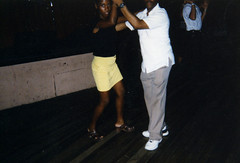
Denalys and I dancing salsa at the Hotel Riviera

I found Global Exchange based in San Francisco and licensed by the U.S. State Department to send people to Cuba. Global Exchange had a partnership with the University of Havana where I took classes with non English-speaking instructors, hung out about town with non-English speaking tutors, and stayed with a non-English speaking family. Wow, talk about language immersion, this truly was it.

Upon arrival, I felt like I was in salsa music heaven. There was salsa music, timba music, and son-montuno music everywhere blaring from homes, business, and cars. At one point, I grabbed a woman in my group, as we were strolling through Central Havana, and we danced right there in public.
Meeting Denalys was only one of the high-points of my trip. Someone whom I would have loved to bring home to mommy and daddy, but that's another story. I had the opportunity to meet a lot of nice people as well as the Havana city slickers who seemed to have felt that all Americans had the same income as Donald Trump. From my growing up in Harlem, NY, I know a hustle when I see one and felt somewhat insulted when they tried to run a game on me.

Untitled-14
José Martí Airport, Havana, Cuba

When my plane (Aero Cubana) landed in Havana, a rush of joy went through my whole body as everyone on the plane applauded. I myself was anticipating a whole new experience in life. As I experienced the island of Cuba, I felt so much closer to my African heritage because of its large black population and the strong influence of the Santería religion. Santería was developed when African slaves used Catholic saints to camouflage their worship of African deities (of the Yoruba tribe) to avoid retribution from Spanish slave owners.
On my last day, heading towards the José Martí International Airport to return to Oakland, I was fighting back tears because I felt so much at home in Cuba, yet there was so much of Havana I have not yet to see. I thought about how much I was going to miss so many down-to-earth, neighborly people I met. Havana, a city of two million people, where total strangers greet each other with “buenas” or “que bolá (what's up). ” I mourned for a long time after returning to Oakland. Vladimir was right. I did not want to come back from Cuba... at least not so soon.

Denayls and I continued to stay in touch by mail, depending on people traveling to and from Cuba through Mexico to get our letters to each other. This process took approximately 30 days at a time.


Tuesday, August 31, 2010

When I Was Cuban


For years, people have suggested and suspected that I just might be Cuban. Just because I rattled off some Spanish to some Spanish-speaking clients at a social service agency in Richmond CA, where I was working at the time, word spread rapidly among staff that I'm Cuban. Why? At a bus stop in a Spanish-speaking community in Oakland, CA, I casually struck up a Spanish-speaking conversation with a woman who was also waiting for a bus. Her immediate response to me was, ¡Ayyyyy, Cubano (ohhhh, you're Cuban)! Now, how did she figure? When I was on vacation in Southern Perú, I thought because I was in a heavily populated black area that I just might fit right in. No. As soon as my back was turned, I overheard someone ask about me, de dónde es, Cuba . (where is he from, Cuba)?. Now, what does Cuba have to do with me? Well, I actually had the opportunity to visit Cuba to find out.


While growing up in New York, I was influenced by my Puerto Rican neighbors to learn Spanish and love salsa music.

I must admit, I did feel at home. There was something about the energy of the Cuban people that made me feel like a long, lost member of the community who finally came home. Words cannot express how uplifted I felt to just walk about town hearing son-montuno music, charanga music, timba music and danzon music blaring from homes and businesses. One day, a group of us were strolling through Central Havana when we heard this loud salsa song coming out of a restaurant. I couldn't take it anymore. I literally reached out and grabbed a woman, and we danced right there in public. Of more than 150 cities and towns in 16 countries that I've visited in my life, Havana is the only place from which I returned feeling homesick; I mean very homesick!


I was born in St. Louis, MO, and lived in a closely knit African-American community called “The Ville.”

Does this make me Cuban? Well, total strangers in Havana assumed I was one until I opened my mouth (LOL)! They couldn't tell by my Spanish where I was from. What was clearly evident to them the moment I spoke----I am NOT Cuban! I can't even fake a Cuban accent. At a popular Havana night spot, I was so flattered when a lovely woman asked my date if she could cut in to dance with me. I took her into my arms and busted one of my favorite salsa moves. She was NOT impressed. She blurted out in astonishment, ¡tu bailas como extranjero/you dance like a foreigner!), and motioned for me to go sit down--go back my woman. I guess she thought I was Cuban too :::::::chuckle:::::::.


Even Cuban people thought I was Cuban until I opened my mouth!

The Cubans have a name for people like me. It's called “Yuma,” a slang word for an American, and rightfully so. I was born in St. Louis, MO and lived in what I remember was a closely knit African-American community called “The Ville” before moving to New York City. It was in New York, where I developed a love for classical music and jazz. But I developed and even greater love for salsa and became a salsero por vida (a salsa music lover for life).. The Spanish that I learned was influenced by my Puerto Rican neighbors, or should I say my New-Yorican neighbors (Puerto Rican born and/or raised in New York). Even a friend from the Island of Puerto Rico, told me that my Spanish has a New-Yorican accent. When I was in Perú and Ecuador, comments were made about my Spanish sounding Caribbean.

So, I have to ask----when was I ever Cuban? Could it have been in another life? I tend to think that just might be the case.