Showing posts with label Afro-Cubans. Show all posts

Tuesday, May 31, 2016

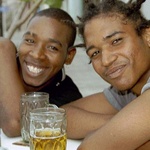
Afro-Cuban Twin Sisters Profit from Cuban Cigars


So many people are taken aback to learn that a increasingly popular Cuban cigar brand is owned by two young Afro-Cuban woman in an industry dominated by older white Cuban males.

Although fluent in Spanish as well as English growing up in a Miami community heavily populated by white Cubans, they were taught to be black and proud by their grandmother, and became bi-cultural as they embraced African-American culture as well as their own Cuban culture interacting and weaving comfortably well in both Latino and African-American communities.  

An ongoing surprise to me is the number of Latinos who seem to be so unaware that there are black folks in their community who, like they themselves, have Spanish-speaking roots. Cubans, of all Latinos, should know better considering that their home country  has an overwhelmingly black population.


Original article:

MIAMI, FL -- When Afro-Cuban-American twin sisters Yvette and Yvonne Rodriguez launched their Tres Lindas Cubanas cigar line last year, they wanted it to represent some of the diverse Cuban races as well as honor their grandmother, who inculcated them with pride in their African roots.
On a recent afternoon in a Coral Gables cigar shop, the twins point out their three signature cigars: "La clarita" - which means fair-skinned - and is light-medium bodied; "la mulata," which means mixed black/white as is medium-full, much like their grandmother; and "la negrita" means black which is their strongest, full-bodied cigar.


Coming from a mixed race family, the twins were somewhat confused when they were growing up in Miami, where the Cuban population is predominantly white. Their mother, a Cuban mulata, and father, a black Cuban, settled in the Miami suburb of Cutler Ridge, which had a mix of races.
"We were Cuban, we were black, and the kids did not understand that," Yvonne said. When their light-skinned grandmother would pick up the twins and their brother from school, students were puzzled to see her fair complexion. "Kids would ask 'who's that?' This light-skinned woman picking up three little black kids," Yvonne said. They recall bus rides home from middle school telling students about their ancestry.

The witty and lighthearted twins speak with adoration of their maternal grandmother and admit they were also confused growing up. "She was a mulata of mixed race but she came out very light skinned," Yevette explained.

Their grandmother emphasized the importance of being proud of being black. When people complimented her for being elegant, she would respond 'an elegant mulata.' Yvette explained "it was weird for us because for me she was just a white woman … she was a white woman saying 'nosotros las negras'[us black women]," they said laughing.

Although their complexion was confusing for them when they were 10 years or 12 years old, when they were a bit older they realized they were comfortable around Latinos as much as they were among African-Americans and weaved comfortably in and out of both communities.
"We could jam out to hip hop or R&B and speak Spanish a few seconds later. We are very in tune with both cultures," Yvonne said.


It was through classic music, food, and stories that Yvette and Yvonne learned about their Cuban culture. "Back then the embargo was real and there was no Internet," Yvonne explained. Their parents were traditional, conservative, and Republican. But growing up in the U.S. they embraced African-American culture in addition to their Cuban culture and found their own identity.
"We don't fit the mold people are accustomed to seeing," Yvonne said.
These variations are the essence of the cigar line, which they say has created a dialogue for those who are confused like they once were.

Sunday, February 2, 2014

What I Know about Santería


What do I know about Santería? Not much, except that it is extension of a West African Yoruba religion, and that African slaves in places like Cuba and Brazil (Candomble) had to take this religion underground, i.e., camouflage it under Catholocism because it was forbidden by their white slave masters. To be caught in openly practicing this Yoruba relation would result in dire consequences. The slaves used the names of Catholic saints in place of Yoruba deities. I had a conversation with a Nigerian gentleman who been to Cuba and feels that the Afro-Cuban is more African than the Africans themselves because the Yoruba language being spoken is the old school Yoruba of the 16th century, not the Yoruba that is spoken in West Africa today mainly by Nigerians. In addition, unlike many Afro-Cubans, many Africans embraced Western religions due to colonialism and the efforts of European and American missionaries.

Being of African heritage myself, a salsa music lover and dancer, and an admirer of Afro-Cuban culture, I thought Santería might be a worthwhile spiritual practice to explore, let alone reunite me with my African roots. After all, I was searching for a true spiritual connection at that time. That's when the touchiness of Santería really began to rear its ugly head, especially among some of my so-called friends who were directly or indirectly involved, and appeared reluctant to introduce me when I openly expressed my enthusiasm. 

To me, their reluctance and defensiveness was a red flag. There is something wrong when people feel that they have to be so clandestine with their connection with a higher power. Born again Christians approached me with open arms. So did Muslims and Buddhists. What is so wrong with Santería being that slavery has long ended? Another concern is why did these Yoruba deities permit the capturing of African people to be put on slave ships, their sufferings during the middle passage, and their oppression long after their arrival in the western world? If anyone reading this can enlighten me, I sure would appreciate it. Like I said, I know very little about Santeria other than the fact that I just might not be missing anything!

Monday, July 1, 2013

Havana City


These days, I have to be careful how I list my studies at the University of Havana in Cuba on my résumé because people tend to think I sneaked into Cuba illegally, and never bother to ask how I was able to enter legally.. I traveled to Cuba through the Global Exchange program, which has a license from the U.S. government to sponsor trips that are educationally and culturally focused. At that time, Global Exchange had a partnership with the University of Havana where Americans can learn and develop their Spanish-speaking skills through total immersion in that the instructors, tutors, and host families speak Spanish only. ....

Being the salsa music lover that I am, I was excited about not only improving my Spanish, but improving my salsa dancing skills as well. In my travels to more than 150 cities in 14 countries, I've never felt so much at home as I did in Havana. It was pure joy to just walk down the street hearing son-montuno music, charanga music, danzon, and timba music blaring from cars, homes, and businesses. One afternoon, there was a group of us walking through Central Havana where we heard this loud salsa song coming out of a restaurant. I grabbed one of the women in our group and we danced right there in public.


The beauty of this trip was that I stayed with a family in the middle of a community where there are hardly any tourists. It was amazing how so many people in the community looked at me and assumed that I was just another Cuban until I opened my mouth. My foreign accent was a dead give-away. I did make some fine friends with people who went out of their way to make me feel like one of them. One was Denalys Fuentes, a cute, petite Afro-Cuban woman who was my salsa dance partner as we went to party at the Palacio de la Salsa (Salsa Palace), a major Havana night club. She and I continued to write each other after my return to the US.

In a city of over two million, I found the Habaneros (Havana City people) to be so pleasant, neighborly; and highly approachable. You don't feel that sense of paranoia and fear when you stop people and ask for directions like here in US cities. It's probably because Havana is a much safer city than "any" mid to large city in the USA, mainly because punishment for crimes are a lot stricter in Cuba, and the potential criminal, more often than not, will think thrice before committing any crimes. The street hustlers, called jineteros (hee-neh-tay-roes), will befriend you and coerce you into spending your money on them. For me, this was an amusing opportunity to practice my Spanish.


Any animosity between Cuban people and the United States lies solely with the two governments, not the people. The average Cuban citizen I met admire American people and American culture. They love it when American visitors bring t-shirts, CDs, and other American-style items they no longer need to give away. In fact, I didn't want to wear any of my Cuban t-shirts that I bought as souvenirs because that would have been another dead giveaway of my being a foreigner. I simply waited until I make it back to Oakland.


Side note: I'd be remiss not to mention the thousands upon thousands of Cubans who fled Cuba and are scattered not only throughout the US but in Europe and Latin America. These Cuban refugees who sought asylum in other countries lived and experienced a Cuba that visitors like myself do not get to see or experience.

Monday, May 20, 2013

For Blacks in Cuba, The Revolution Hasn't Begun


I had the opportunity to visit Cuba (legally) back in 1998 to take a Spanish-language intensive course at the University of Havana, but was not there long enough to notice the apartheid type policies that were in place because I was protected by my US passport and dollars. At that time, US currency coveted by Cuban businesses for circulation. We foreigners from everywhere were having the time of our lives, totally oblivious of so many naturalized Cuban citizens risking their lives to escape and seek asylum in places, like the US, Spain, Mexico, and Perú.

My Afro-Cuban neighbor here in Oakland, CA, connected me with his family in Havana, but never explained to me why he himself faced the perils of the waters to escape Cuba on top of an inner tube of a tire. None of his friends whom I also befriended ever complained or reprimanded me for visiting Cuba, like so many other Cuban refugees who left Cuba long before them.


--W Bill Smith


By Roberto Zurbano, editor and publisher of La Casa de las Américas (House of the Americas) publishing house. This essay was translated by Kristina Cordero from the Spanish.

CHANGE is the latest news to come out of Cuba, though for Afro-Cubans like myself, this is more dream than reality. Over the last decade, scores of ridiculous prohibitions for Cubans living on the island have been eliminated, among them sleeping at a hotel, buying a cellphone, selling a house or car and traveling abroad. These gestures have been celebrated as signs of openness and reform, though they are really nothing more than efforts to make life more normal. And the reality is that in Cuba, your experience of these changes depends on your skin color. 

The private sector in Cuba now enjoys a certain degree of economic liberation, but blacks are not well positioned to take advantage of it. We inherited more than three centuries of slavery during the Spanish colonial era. Racial exclusion continued after Cuba became independent in 1902, and a half century of revolution since 1959 has been unable to overcome it. 

In the early 1990s, after the cold war ended, Fidel Castro embarked on economic reforms that his brother and successor, Raúl, continues to pursue. Cuba had lost its greatest benefactor, the Soviet Union, and plunged into a deep recession that came to be known as the “Special Period.” There were frequent blackouts. Public transportation hardly functioned. Food was scarce. To stem unrest, the government ordered the economy split into two sectors: one for private businesses and foreign-oriented enterprises, which were essentially permitted to trade in United States dollars, and the other, the continuation of the old socialist order, built on government jobs that pay an average of $20 a month. 

It’s true that Cubans still have a strong safety net: most do not pay rent, and education and health care are free. But the economic divergence created two contrasting realities that persist today. The first is that of white Cubans, who have leveraged their resources to enter the new market-driven economy and reap the benefits of a supposedly more open socialism. The other reality is that of the black plurality, which witnessed the demise of the socialist utopia from the island’s least comfortable quarters. 

Most remittances from abroad — mainly the Miami area, the nerve center of the mostly white exile community — go to white Cubans. They tend to live in more upscale houses, which can easily be converted into restaurants or bed-and-breakfasts — the most common kind of private business in Cuba. Black Cubans have less property and money, and also have to contend with pervasive racism. Not long ago it was common for hotel managers, for example, to hire only white staff members, so as not to offend the supposed sensibilities of their European clientele. 

That type of blatant racism has become less socially acceptable, but blacks are still woefully underrepresented in tourism — probably the economy’s most lucrative sector — and are far less likely than whites to own their own businesses. Raúl Castro has recognized the persistence of racism and has been successful in some areas (there are more black teachers and representatives in the National Assembly), but much remains to be done to address the structural inequality and racial prejudice that continue to exclude Afro-Cubans from the benefits of liberalization. 

Racism in Cuba has been concealed and reinforced in part because it isn’t talked about. The government hasn’t allowed racial prejudice to be debated or confronted politically or culturally, often pretending instead as though it didn’t exist. Before 1990, black Cubans suffered a paralysis of economic mobility while, paradoxically, the government decreed the end of racism in speeches and publications. To question the extent of racial progress was tantamount to a counterrevolutionary act. This made it almost impossible to point out the obvious: racism is alive and well. 

If the 1960s, the first decade after the revolution, signified opportunity for all, the decades that followed demonstrated that not everyone was able to have access to and benefit from those opportunities. It’s true that the 1980s produced a generation of black professionals, like doctors and teachers, but these gains were diminished in the 1990s as blacks were excluded from lucrative sectors like hospitality. Now in the 21st century, it has become all too apparent that the black population is underrepresented at universities and in spheres of economic and political power, and overrepresented in the underground economy, in the criminal sphere and in marginal neighborhoods. 

Raúl Castro has announced that he will step down from the presidency in 2018. It is my hope that by then, the antiracist movement in Cuba will have grown, both legally and logistically, so that it might bring about solutions that have for so long been promised, and awaited, by black Cubans. 

An important first step would be to finally get an accurate official count of Afro-Cubans. The black population in Cuba is far larger than the spurious numbers of the most recent censuses. The number of blacks on the street undermines, in the most obvious way, the numerical fraud that puts us at less than one-fifth of the population. Many people forget that in Cuba, a drop of white blood can — if only on paper — make a mestizo, or white person, out of someone who in social reality falls into neither of those categories. Here, the nuances governing skin color are a tragicomedy that hides longstanding racial conflicts. 

The end of the Castros’ rule will mean an end to an era in Cuban politics. It is unrealistic to hope for a black president, given the insufficient racial consciousness on the island. But by the time Raúl Castro leaves office, Cuba will be a very different place. We can only hope that women, blacks and young people will be able to help guide the nation toward greater equality of opportunity and the achievement of full citizenship for Cubans of all colors.

Wednesday, October 17, 2012

Havana City Slickers


I grew up in New York City, so I know a hustler when I see one. I don't care if I'm in Tokyo, Montreal, or Havana; a hustler is a hustler, and they give off the same vibes that is instantly recognizable--usually!. At the time of my Havana visit, I only brought $250 worth of spending money to last me two weeks. This was money for souvenirs, dating, and entertainment. Although, I was successful stretching my money to last a couple of weeks, I only had $10 in my pocket when I arrived at Havana's José Martí International airport heading back to Mexico City, before catching my flight back to Oakland, where I now live. Because Cuba does not recognize American banks, I could not use a credit card or an ATM until I arrived in Mexico.

Many of the Havana hustlers, or jineteros (pronounced Hee-neh-teh-rohs), as they are called in Cuba, are Black like me. However, they viewed me as a rich tourist first and a Black man second. All I could do was play with their minds when they approached me with their little games. I even got to the point where every time a jinetero would approach me, I would say something like, ¿qúe bolá? ¡Quiero ser jinetero como tú, asere! (what's up, I want to be a hustler like you, man).  They would always give me a nice little chuckle and move on.

The most interesting case of my being hustled, and not knowing it was when I hired Ernesto, a Black bicycle-taxi driver with whom I began to establish rapport and get advice on things to do about town. I'd arrange for him to pick me up at certain places at certain times. One day, as he was taking me to my Spanish language intensive class at the University of Havana, he told me that this Wednesday night, there was going to be a birthday party for his little niece. He also told me that he wanted to introduce me to a nice woman. He even introduced me to someone whom he claimed to be his brother, and his brother looked at me as though I were a gold mine; a Black gold mine, thus easier pickings.

Wednesday evening came around, and I forgot all about this little party as I was with Luisa, an attractive woman whom I met the first day I arrived in Havana. As Luisa and I returned from a local restaurant, heading back to her house, we ran into Ernesto who had just stopped by the place where I was staying. He was visibly annoyed. His so-called brother was in the car with a group of other guys driven by one of Ernesto's friends. It certainly looked like a set-up. They wanted to party hearty with plenty of food and liquor at my expense.

When I returned to the place I was staying, which was across the street from Luisa's apartment complex, I was told by several house-hosts that it is very unusual for anyone in Cuba to have a party for a child on a Wednesday night, and they vehemently warned me about fooling around with jineteros, people who hustle foreigners, most of whom have regular jobs, white and blue collar, and moonlight hustling tourists. This is big business in Havana

Sunday, May 23, 2010

Luisa of Havana


The "El Vedado" section of Havana, Cuba where I stayed

One Saturday morning, on a quiet street in the El Vedado section of Havana, Cuba, my classmates and I, who were attending the University of Havana, were mounting our bicycles getting ready for a guided tour of the city. I noticed an attractive Afro-Cuban woman observing us from across the street. When I went over to introduce myself, and her eyes lit up like a neon sign. I could hear virtual cash registers ringing in her head. Just because I'm an American she seemed to have felt that I must be a black relative of Bill Gates or Donald Trump. And she sought to get what she could.

I saw Luisa as opportunity to practice my Spanish and get immersed in Afro-Cuban culture.

In turn, I saw Luisa as opportunity to practice my Spanish and get immersed in Afro-Cuban culture. I met her two children Miguel (7) and Ingrid (5); her mother Isabel, and her brother Ronaldo, as well as another one of her sisters. They lived in a rough-looking housing project across the street from where I was staying. However, after visiting Luisa numerous times, I realized that, although the people were poor, there was hardly any crime.


The first time Luisa and I were alone, her first and most earnest request was that I take her back to the United States. The last thing I wanted in Cuba was a wife; especially a wife who can't see past my wallet. What about my looks, charm, and content of my character? As we spent more and more time together, she started telling her mother, brother and sister, that I was going to take her home with me. My response to her, in private, was that I would prefer to stay here in Cuba, and together we can support the revolution. That shut her up! But later, as she and I went shopping, she lured me over to the appliance section trying to get me to buy her a refrigerator. That was way over my vacation budget.

The last thing I wanted in Cuba find a wife; especially a wife who can't see past my wallet.

As I got to know Luisa better, I realized that she was not being devious. She was desperately trying to make ends meet for her and her two children. When the Russian economy fell, the Russians could no longer support Cuba economically as they had been doing since the 1960s. And with this ongoing, unrelenting trade embargo against Cuba, it was evident that this embargo is not hurting Castro and his henchman nearly as much as it is hurting innocent people like Luisa and her children.

This ongoing, unrelenting trade embargo against Cuba is not hurting Castro and his henchman nearly as much is it is hurting innocent Cuban citizens.

For this reason, I felt good about helping Luisa and her family in ways I could afford. The day before my departure, I gave the children Miguel and Ingrid gifts that they thoroughly appreciated; gifts that average American children take for granted. You can just see the exhilaration in their eyes.

After returning home to Oakland, Luisa and I stayed in touch by phone and by mail. I still have her letters. I just feel bad that it is so difficult to send money or gifts without the Cuban government's greedy interference. I tried to send gifts through Global Exchange, the organization that sponsored my trip, but the gifts never arrived. Luisa, her children,and her mother and are friends separated by politics.