Showing posts with label Venezuela. Show all posts

Friday, April 25, 2014

Tourist in the Hood—VENEZUELA


I saw so many resemblances of “the hood;” impoverished blacks (and browns), businesses owned by Asians and Middle Easterners, and young black men with hats on backwards and baggy pants. There were even men hanging out on the corner; not to the extent of that in the US, but they got my attention because they were listening to salsa music instead of hip hop. As a salsa music lover, I joined them and was thrown off by their Ebonics [Spanish Ebonics] to which I have found challenging to understand throughout my trips to Black Latin America.

As I walked the streets of the community, no one suspected that I'm American with the exception of one Middle Eastern store owner. This was good because I did not want to attract hustlers, con artists, and robbers erroneously getting me mixed up with a someone from Beverly Hills. I was told by a Venezuelan engineer that a white person speaking Spanish with a foreign accent is perceived as an international traveler, but a black person like me who also speaks Spanish with a foreign accent will be perceived as an immigrant from the Caribbean, like those of  nearby Trinidad and Tobagoi. He encouraged me to take advantage of this perception for my own safety.

This was the city of Higuerote (pronounced EE-GAY-ROTE-TAY) in Venezuela's region of Barlovento, the hub of Afro-Venezuelan culture. Higuerote is the current home of Jesus “Chucho” Garcia the father of black Venezuelan history. It was his published book that I read years ago entitled “Africa in Venezuela” that planted a desire in my heart to visit Barlovento. The book addresses the history of black Africans being brought to Barolovento to work the Cacao plantations supplying manufacturers with the ingredients to produce chocolate goodies to sell to the world during the 16th Century . Today, Afro-Venezuelans continue to carry on their African traditions, which can be heard in their music called Tambor.

Unlike so many places in the US, blacks and browns live in harmony, and in many cases, are family. This is the case in many other parts of Latin America as well. For example, my goddaughter Daniela in Perú is the only black in her family and is equally loved. Many of the brown-skinned Venezuelans have African blood in their veins. The late-president Hugo Chávez, has African blood from his father's side, and wore an Afro hairstyle in his youth.

Another trait that I found in Higuerote that reminded me of the hood was the indifference and lack respect that the average storekeeper and street vendor show their customers in the community. It seems that they feel that they are doing their customers a favor by being in business when in reality, it's the customers who are putting food on their tables. And just as in the US ghetto, people continue to patronize those businesses versus demanding respect and seeking other places to spend their money if they don't get that respect.

An Asian grocery store clerk aggressively shouted the price of an item at me with her hand stuck out, and did not bother to give me the professional courtesy of a “thank you” after paying her. On another occasion, I bought an empanada, which was indescribably delicious, from a black street vendor, who also did not demonstrate any professional courtesy for patronizing her business. In both instances, I shouted gracias/de nada (thank you/you're welcome) thinking they might get the message. I thought to myself that if this were my business, I could make an awful lot of money because I know how to treat customers who are putting money into my pockets; thus, attract and maintain more customers—this is hardly rocket science.

As a man, I found the women, of all colors, to be very curious, friendly, and conversational. Almost every time, I'd smile and wave at a woman, I'd get a happy, enthusiastic smile and wave in return. One woman referred to me as “primo (cousin or cuz)” when I greeted her on the street .  There were other women who gave me strong eye contact and became cheerful when I made conversation. It was just too bad that I was only there for short time as there was a lot more to Venezuela's region of Barlovento that I wanted to see. There was Rio Chico, Curiepe, San José, and Chirimena with all of their fine beaches and live music. I wanted to visit cacao plantations and the Afro-Venezuelan Network, but I had to catch my flight back to San Francisco, CA. There is still much, much more to explore in Black Latin America.


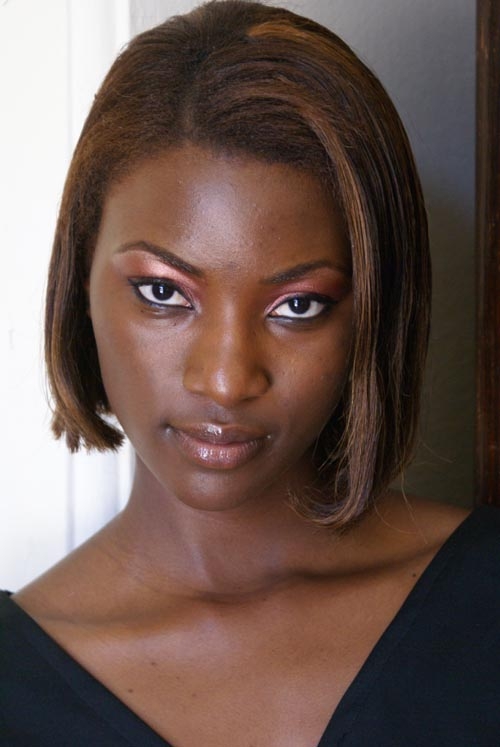
Black Beauty in Venezuela


Wednesday, January 29, 2014

I Got “Taken” in Caracas, Venezuela

As I was planning my trip to the Region of Barlovento, the hub of Afro-Venezuelan culture right down to every last detail, I learned that I had to pass through the notorious capital city of Caracas, ranked #3 as the most dangerous city in the world. Venezuelans living here in the US actually warned me saying, “dude, the barrios of Caracas are way worse than Harlem, where I grew up,  and Oakland, where I now live, which is ranked as #45. One of my co-workers who happened to be from Caracas used to look at me with sad eyes as he kept giving me subtle hints that I should consider other places to spend my vacation. 
Well, when it was all over, I not only came back home healthy, ed, and in one piece, I actually had a nice time. I just happened to have met the right people on www.couchsurfing.com (a web site for travelers) who looked after me, took me in their homes, and showed me around. I didn't notice any hints of all the horrible things I read and heard about Caracas. Even the biggest and the “baddest” hood in the city, Barrio Petare, where I had to catch my bus to Barlovento, appeared tranquil. It was as if I was being watched over by a higher power. I was even able to get a much better exchange rate in Venezuelan currency for my American dollars, thus having much more spending power.
Despite an overall successful trip, only one thing went wrong; nothing as serious as the things of which I've been warned. I got taken for my money buying CDs of Venezuelan music as part of my souvenir collection. In the region of Barlovento, I did not see any major music stores like what we have here in the US, only guys on the street selling pirated CDs. Those CDs turned out to be tolerable, but of poor quality. Even worse, back at the airport while waiting for my flight out of Caracas, there were hordes of young people, many in their teens, hawking their collection of pirated CDs. I bought about $35.00 worth only to find when I got back home that those kids, or whomever they were working for, got over like big, fat rats. Those CDs were blank. 
I just sucked it up as a lesson learned. In the days of iTunes, Spotify, and Rhapsody, I really do not have take anymore risks here or abroad.

Thursday, May 16, 2013

A Little Taste of Caracas


I've always wanted to visit Venezuela after reading the book entitled Africa in Venezuela by Jesus “Chucho” Garcia. As many African-Americans know, Carter G Woodson is the father of Black history in the US. Well, Jesus García is the father of Black history in Venezuela. My opportunity to visit Venezuela came in December of 2011. However, as I was planning my trip, my co-worker León who is from Venezuela's notorious capital city of Caracas, discouraged me from going saying that it is too dangerous. I explained to León that I wanted to spend my vacation in the Region of Barlovento, the hub of Afro-Venezuelan culture, and not Caracas. León insisted that every corner of Venezuela is dangerous. I asked him that if I could pass as a poor, unemployed, Black Venezuelan would that make me safer? He laughed and said no, thugs do not discriminate when choosing their victims!


Felix, a Venezuelan friend and guide 
I met on couchsurfing.com

As I set about to do my homework on Venezuela, reading travel guides and doing web research, and joining message boards, like I do prior to every trip that I take, I learned that the crime statistics in Caracas, especially in the barrios (the hoods), which are located in the hills, would make the worst gang-infested cities in the US appear like havens of rest. One Venezuelan in an on-line forum told me that if I even think about going  into one of the barrios to make sure I bring an Uzi. León used to simply look at me with sad eyes as I continued to plan my trip, but as time passed, he began to feel better and more confident about my ability to handle myself as I kept him advised of all of my preparations. I even downloaded over 100 Venezuelan slang words to incorporate into my vocabulary, like epa, primo (what's up bro, or what's up, cuz)? León finally told me that I was ready. As in all of my travels, I made Facebook friends to establish warm contacts in advance of my arrival. However, my best and most rewarding efforts came through couchsurfing.com, a web site where travelers can get inside information on a country from local citizens, and even arrange for free accommodations and tours.

María, a Venezuelan friend and guide 
I met on couchsurfing.com

There was Felix who picked me up at the airport and showed me around Caracas before taking me home to meet and dine with his family and fiancee, and gave me a free place to sleep for the night. He also made arrangements for me to change my American dollars into two times the normal exchange rate giving me far more spending power during my five days in the country. Knowing that I wanted to go to Barlovento, the hub of Afro-Venezuelan culture, he texted María, another person whom I met on couchsurfing.com who has family in that area, and turned me over to her the next day. María herself took me around town as we wined and dined before finally taking me to the biggest and 'baddest' hood in all of Caracas, Barrio Petare. This was the place to catch my bus to Venezuela's Region of Barlovento.


Caracas, Venezuela


All in all, I spent a total of three days in Caracas and found everyone I encountered to be cordial and helpful. I did not come close to experiencing or even observing any of the dangers I heard and read so much about. Sure, I met some slick hustlers, but after having grown up in New York City, that didn't phase me. At the airport, where I was warned to be careful, I got burned for about $30 American dollars by some sweet looking men and women roaming the airport selling CDs of Venezuelan music of which I purchased as souvenirs before catching my flight out. When I got home, I learned that those CDs were either blank or of very poor quality. León, however, was so happy that I made it back to work alive and in one piece. He was pleasantly surprised and delighted that I had such a wonderful and memorable time. My little taste of Caracas was truly an answer to prayer.

Thursday, March 28, 2013

Hugo Chavez and the Black Community

“The U.S. media's portrayal of Venezuela "has nothing to do with reality.” 
-- Actor Danny Glover

While planning my trip to Venezuela, I had planned on making it plain to immigration and others I meet upon my arrival my admiration for Hugo Chávez. I was then warned, not only by the travel guides I was reading but in my communication with Venezuelans in a couple of online forums. They stated that comments for or against Chávez, depending on who you are taking to, can be very touchy. Of course, the same could be applied here in the US when it comes to politics, which is one of the reasons I generally do not discuss politics, especially with strangers. However, the predominately Black Region of Barlovento in Venezuela, where I visited, is a known Chavista (Chávez supporters) stronghold.

Hugo Chávez however, the lateVenezuelan president, has boldly sought to forge ties with poor communities of color in the United States. In the wake of Hurricane Katrina, Chávez provided relief assistance to the poverty stricken and largely African American victims of that disaster. The head of Citgo, the U.S. subsidiary of Venezuela's oil company, set up disaster relief centers in Louisiana and Texas in the wake of the hurricane and provided humanitarian relief to thousands of victims in terms of medical care, food and water. Chávez expanded his program to the predominately African-American and Latino South Bronx. While in New York, Chávez toured the poorest congressional district in the nation's richest city, the South Bronx, and was treated like a veritable rock star.


Hugo Chávez himself is of mixed racial roots. In an interview, Chávez remarked that as a young man applying to the military academy, he was wearing an Afro and has not sought to distance himself from his ethnic heritage. His Indegenous roots are from my father's side who is also of mixed African heritage. Like many other Venezuelans of color, Chávez grew up in poverty as a farm kid from the plains." Chávez entered the military, which historically has been one of the few paths towards social advancement for men of color. While on duty, he toured the country and became aware of economic exploitation and racial discrimination.


As Afro Venezuelan groups celebrated the 150th anniversary of the end of slavery in Caracas, Chávez made an appearance and some participants expressed optimism that racial progress would be made under the Chávez government. The TransAfrica Forum sent a delegation of influential African-American artists, actors, activists, and scholars to Caracas to meet with government officials. The group included screen actor Danny Glover who expressed his excitement at the social changes taking place in Venezuela. Glover remarked that the U.S. media's portrayal of Venezuela "has nothing to do with reality." Glover and others presided over the inauguration of a new "Martin Luther King., Jr." school in the coastal town of Naiguata. The area is home to large numbers of Venezuela's Black community. The school inauguration was the first official Venezuelan recognition of the importance of the slain civil rights leader.

Meanwhile, Chávez has cultivated ties with civil rights leader Jesse Jackson. Speaking later at the National Assembly, Jackson discussed the role of Martin Luther King Jr. during the civil rights struggle. Jackson praised Venezuela for making slavery illegal prior to the United States. "You in Venezuela ended the system of slavery in 1854," he remarked (the US ended slavery in 1865). At the end of his speech Jackson was cheered with thunderous applause from Venezuelan lawmakers.

Friday, May 11, 2012

Just Five Days in Venezuela


Years ago, when I decided to seriously adopt Spanish as a second language, I used to randomly make conversation with those whom I perceived to be monolingual Spanish-speakers. Because I'm black, they'd usually assume that I'm from Puerto Rico or Cuba. So, just to play with their minds, I used to tell them I'm from Venezuela; in other words, there are blacks all over Latin American, not just Puerto Rico and Cuba. Pretty soon, I started taking a genuine interest in Venezuela and have always wanted to visit. My opportunity finally came in December 2011. 

Although I was only going to spend five days, I wanted this trip to be a smooth, drama-free, five-day learning experience. Therefore, I spent months doing research on Venezuelan culture and lifestyle. I studied their currency, and their public transportation. However, my main reason for visiting Venezuela was to explore the predominately black region of Barlovento where African slaves were brought to work the cacao plantations in the 16th century, and where many of those slaves escaped and found refuge in heavily armed fortresses called cimarrones. 

In order to get to Barlovento, however, I had to pass through the notorious capital city of Caracas where the crime statistics makes cities like Detroit, St. Louis, and Oakland look like they are having church. Naturally, I did my research on safety measures as well. I had a co-worker from Caracas who tried to discourage me from going to Venezuela at all, and told me that he himself feels “safer” walking the streets of Oakland. Thus, I had no intentions of spending no more than a few hours in Caracas, either going or coming. 


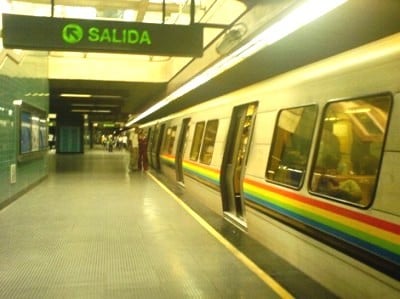
Caracas subway system; The Metro
 

On Thursday, December 1, 2011, I flew in from Perú where I spent the last two weeks and landed at the Simón Bolívar International Airport, which is about a two-hour bus ride from Caracas. Unlike other Latin-American countries I've visited, it was nice to see more than one black person working in immigration as they and the security staff cleared me and let me onto the main floor of the airport where I was to meet Felix, my host whom I met on couchurfing.com, a website for travelers. 

Of nine Spanish-speaking countries I've visited, including Cuba, where people talk so fast that they chop their words, Venezuela is the first country where I had to tell people, more than once, to slow down because Spanish is not my first language. I've heard Spanish speakers complain about their difficulty in understanding Cubans and Puerto Ricans, but the everyday working-class Venezuelans are literally “off-the-hook!”
   
After picking me up at the airport, Felix first showed me the city, and we came across a band playing live Venezuelan music. I was definitely feeling these genres of music; tambor, parranda, and gaita. I really like llanero music from the plains of Venezuela, which is equivalent to the US's country and western. Like in every country, Venezuelan music is diverse. After the musical event, we took a bus to his home up into the hills. 

In Caracas, as in many South American cities, the barrios (or the ghettos) are in the hills, not in the flat-lands. Felix granted me a bed in his cramped home where I met his family and his girlfriend. He also arranged for me to exchange my American dollars into twice the standard Venezuelan exchange rate.


Arepas


As I dined at the dinner table with the family, for the first time, I ate a popular Venezuelan dish called arepas, made of thick corn tortilla filled with chicken, beef, cheese, or anything you want. The next morning, after eating a breakfast-arepas filled with scrambled eggs, Felix and I took the Caracas metro train around the city, and he finally handed me over to a woman whom I also met on  couchurfing.com, Maria, who has family in the Region of Barlovento, the place that I've always wanted to visit. However, I ended up spending more time in Caracas than planned, as María and I wined and dined as she showed me the city. 

The next morning, María escorted me to, what I heard, was the biggest and the “baddest hood” in Caracas—Barrio Petare. This was the most convenient place to catch a bus to Barlovento, the hub of Afro-Venezuelan culture. It was in the town of Higuerote in Barlovento where María and I again dined, went shopping, and toured the area. After she got me settled in a place to stay, she had to return to Caracas for personal business, but she was worried about my safety.
 

Higuerote reminded me of a typical “hood” in the U.S., cool dudes strutting with their hats on backward, stores owned by Asian and Middle Eastern immigrants, and guys hanging on the corner on Friday nights. The big difference is that the people don't listen to hip-hop, they listen to salsa; they don't speak Ebonics, they speak Españolbonics (Spanish Ebonics), which was difficult for me to understand as one guy gave me a hard thuggish look seemingly wondering where I was from.  María already warned me about appearing too touristy. I assured her that I'm from Harlem and I live in Oakland; I can handle myself. She just shook her head and bluntly reminded me that I am now in Venezuela, and it's risky enough that my Spanish has a foreign accent.


Venezuelan empanadas are so delicious they will make you scream


Unfortunately, I didn't get a chance to see the more cultural aspects of the Region of Barlovento with its African tambor music and cacao plantations, and the opportunity to meet progressive members of the Afro-Venezuelan Network. My five days were almost up, because again, I spent more time in Caracas than planned, and I had to head back to the airport.

A memorable part of my trip was a dish called empenadas, an indescribably delicious pastry, baked or fried, that I had for the first time, and like arepas, they are filled with meat, vegetables, cheese, or anything you want. The tastiest ones were made and sold by street vendors. I was hooked. 

Another memorable part of my trip was the friendly, pleasant demeanor of the Venezuelan women I encountered. “Buenas días, buenas tardes, buenas noches,” I would say to various women in my presence, and they would all respond with genuine warmth. Almost every time I'd smile at a woman, she'd give me a happy, enthusiastic smile in return. One woman whom I greeted on the street smiled and referred to me as primo, which literally means cousin, but in Venezuela, it is a colloquial expression suggesting familiarity.

Overall, I was deeply touched by what I experienced from both Felix and María, which goes to show that you will always find good people anywhere, regardless of the reputation of the places you visit. As a practice, I always pray and get prayed for before every trip, and my five days in Venezuela was surely an answer to prayer.

Tuesday, December 27, 2011

Fond Memories of Venezuelan Women

The friendly, pleasant demeanor of Venezuelan women was one of the most memorable part of my trip.


It was Thursday, December 1, 2011, when I stepped off the plane in Caracas, Venezuela; got cleared by security and immigration, and made it onto the main floor of the Maiquetia International Airport. It was so refreshing to notice how friendly, conversational, and relaxed the women are as one had no qualms about asking me about my luggage. Mind you, there is not a city in the United States that comes close to the crime statistics of Caracas, and that includes Detroit, St. Louis, and Oakland. In fact, I have a co-worker from Caracas who feels “safe” in Oakland.

As I passed through the airport, I noticed a Black Venezuelan woman looking at me intently. I gave her a joyful smile, not out of flirtation, but out of happiness to see a sistah (a soul sister). Because of my smile, she looked at me even harder seemingly thinking we might know each other. I didn't have time to stop and chat because I was looking for someone who arranged to pick me up.


While I was riding the metro train, a white Venezuelan woman overheard me speaking English with my friend and guide, María, and I couldn't help noticing this woman watching me with a delightful smile. I immediately greeted her in Spanish and made lightweight conversation of which she seemed very pleased. “Buenas días, buenas tardes, buenas noches,” I would say to various women in my presence, and they would all respond with genuine warmth; not lust, not romantic interest, simply warmth. Almost every time I'd smile at a woman, she'd give me a happy, enthusiastic smile in return; not in a come-on kind of way, but out of friendly enthusiasm. The last time I smiled at a woman in San Francisco, CA, where I work, she immediately picked up the pace of her stride, and created as much distance from me as possible.


In the predominately Black Region of Barlovento, one woman referred to me as primo when I greeted her on the street. Primo literally means cousin, but in Venezuela, it is a colloquial expression suggesting familiarity. As I was heading back to the airport to catch my flight to Miami, a woman who doesn't know me from Hugo Chávez sat next to me on the bus and made conversation with me until she reached her stop. 

During my whole trip to Venezuela, I encountered no negative attitudes, defensiveness, nor the paranoia that I'm so accustomed to experiencing in the United States of America. The friendly, pleasant demeanor of Venezuelan women (next to eating empenadas) is the most memorable part of my trip.

Thursday, May 26, 2011

Africa in Venezuela


As I plan my trips to explore black heritage in Latin-America, I chose Venezuela as one of the main countries to visit. For years, I've always wanted to visit Venezuela because I used joke around with Latinos telling them that I'm Venezuelan. I did that to send a subtle message that not all blacks who speak Spanish are from Cuba or Puerto Rico. I've been asked more than once if I'm from either of those two countries, especially by Mexicans and Mexican-Americans. I am self-taught in Spanish, and am still learning, but obviously my Spanish is impressive enough for some people to think I'm a native speaker.

Barlovento eventually became one of the many runaway-slave settlements called a cimarrón.


Most of my time in Venezuela will be spent in the predominately black region of Barlovento. The Barlovento region is west of Caracas, the nation's capital, in the state of Miranda going towards the Caribbean Sea.
Barlovento is famous for its cacao and is considered to be among the best in the world. During the Trans-Atlantic slave trade, the Spanish imported slaves from Africa to work on cacao plantations, from which cocoa, cocoa butter, and chocolate are made and exported to Europe creating wealth for the slave masters. Barlovento eventually became one of the many runaway-slave settlements called a cimarrón. By the time slavery was abolished in the 1820s, a significant number of free black folks were settled in Barlovento. Most of these ex-slaves and descendants of these ex-slaves continued the legacy of cacao production in the region.


The Barlovento Region of Venezuela
Like Nat Turner in the U.S., Yanga in Mexico, Bioho in Colombia, and Illescas in Ecuador, rebel slave leaders rose in Venezuela as well. The most famous uprising occurred in 1552 when the rebellion was led by El Negro Miguel who raised a military force of 1,500 slaves to attack Spanish settlements. Rebel slave communities continued to grow throughout the 1600s, and by the year 1720, there were up to 30,000 cimarrones (escapred slaves) in Venezuela, compared to those 60,000 still serving their masters.


African slaves were imported to work on the cocoa plantations of Venezuela to produce all sorts of chocolate goodies.

Just as in other parts of the Americas, cimarrones (runaway slaves) were often assisted by indigenous peoples as they conducted raids on plantations, freeing the slaves and trading contraband. The town of Curiepe in Barlovento was the only legally established town of free Blacks. Curiepe was made up of former members of Caracas's Company of Free Blacks as well as escaped slaves from non-Spanish-speaking islands who were given their freedom in Venezuela, only under the condition that they get baptized.


Every year, June 24, Afro-Venezuelans Celebrate Día de San Juan (St, John's Day) with drumming and dance. 

Black Venezuelans played a decisive role in their country's War of Independence. South American liberator Simón Bolívar thoroughly understood the strategic importance of black soldiers and abolished slavery in 1812 and again in 1816. Bolívar being a slave master himself freed 1,000 of his own slaves, and recruited 5,000 slaves into his army. One of Bolivar's most famous lieutenants, Pedro Camejo, is known in Venezuela's history books as "El Negro Primero (The First Black)," because he was always the first to ride into battle.

A statue of El Negro Primero today stands in the Plaza Carabobo in Caracas—the only statue commemorating a Black in all Venezuela. Throughout the War of Independence, Venezuela, slavery continued to decline. By 1821, a new law was on the books declaring all black newborns as free. And by 1854, slavery in Venezuela was completely abolished. Still blacks endured racial discrimination despite a government philosophy that all racial groups blend together. I've met non-black Venezuelans who believe that all Venezuelans are one and that there is no racism.

However every year, public festivals such as the Fiesta de San Juan (June 24) celebrate pride in Afro-Venezuelan culture making bold statements in their resistance to the dominant culture and consciousness of being a marginal community.

African Music in Venezuela