Monday, September 7, 2015

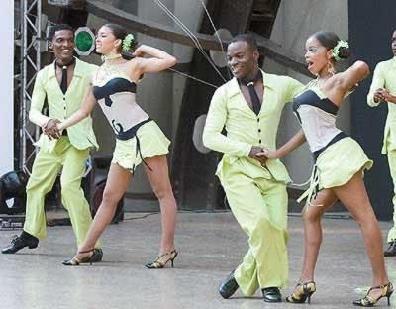
Black People Dancing to Spanish Music

Nicaragua's black community has its own Spanish music of African roots

One evening at a salsa club in San Francisco, California, I asked a olived-skinned Latin-American woman to dance. I can tell by the look on her face that she wanted to dance with me, but doubted that I (this black guy) know how to dance to this type of music. To avoid any embarrassment or frustration, she played it safe and declined my invitation. She later appeared pleasantly surprised when she saw me dancing smoothly and joyfully with other women, and seemed to be hoping that I would ask her to dance one more time. I felt no need to bother because there were too many women willing to dance without question or concern about race or even dancing ability.

In Paraguay, South America there is a renown 
black dance troupe known as Kamba Kue

It was during my high school years in New York City when I first  saw black people dancing to Spanish music. One day after school, my black-American classmates, Lucious and Deborah, were dancing to a popular song called “Mozambique” by the Latin music icon Eddie Palmieri. In those days, Palmieri had a lot of black-American fans in the New York City area as did other Latin music giants like Ray Barretto, Willie Colón, and Joe Cuba.

Puerto Rico's world famous salsa group, El Gran Combo, is directed 
by it's founder, a black man by the name of Ithier Nadal

Years later, at an Oakland, California salsa dance club, I told a black American women, who happened to be attracted to Latin-American men, that if it were not for black people, there would be no salsa. She asked, naively, how do I figure. I didn't have the time nor the inclination to lecture her on the dance floor, but as I myself got better educated and more culturally aware, I learned that people of African ancestry played major roles in the creation of the most popular Spanish music genres throughout Latin America, and that includes the tango of Argentina, and cumbia of Colombia, which made its way through Central America and Mexico. 

Black Peruvian women dancing to the Afro-Peruvian festejo music

More than 100 years before slaves ships began docking in the USA, slave ships have been transporting African people all throughout Latin America. And just as the blacks in the USA created blues and gospel music based on their immediate cultural environment; bomba and plena music was created by blacks in Puerto Rico; candombé music by blacks in Uruguay, and jarocho music by blacks in Mexico. Every country in the Western hemisphere has a history of slavery, and thus, have their own music and dance based on their African roots.

Concha Buika, West African born singer, grew up in Spain 
where she gave flamenco an African flavor.

Most of us in the U.S. do not know that there are more black people scattered throughout Latin America who speak Spanish and dance to Spanish music than there are black people in the U.S. who speak English and dance to R&B and hip hop. As the Latin-American woman who declined to dance with me because of my color, many of us here in the U.S. are living in a bubble thinking you have to look like Ricky Martin and Jennifer López to know how to dance to any type of Spanish music. That is pure bull!

Wednesday, September 2, 2015

Message to My Dissenting Blog Readers


Folks,

It has been almost six years since starting this blog, and I received a lot of wonderful feedback. I even developed a following of 235 members, plus an additional 135 Google connections.

One of the things that makes blogging so interesting is when people express disagreement with my views. I welcome such opposing comments because they do give me broader perspectives on things, and who knows, I just might learn something. 

My only request is that you woman up or man up; have the moral fiber, the intestinal fortitude to back your points. Don't just attack my writing and run away before I can respond with a thought that might be different from yours.. That is just plain cowardly! I love a good debate because it subliminally enlightens and sharpens all parties involves.

Sunday, August 23, 2015

Professionalism and the Lack Thereof in the Afro-Latino Community

 
I am posing with a true professional in El Carmen, Perú;
the owner of Mamainé—Peruvian soul food restaurant 

I don't know if it's a spoiled American attitude or what, but anytime, I'm parting with my hard-earned cash, I “expect” to be treated with some warmth and respect just as I would equally treat others who are putting money into my own pockets. I don't think that is an unfair trade-off.

When traveling through Latin America, I make it my business to connect with Afro-Latinos as much as possible because I want to learn more about the black experience in those countries. And if a black is running a business, or at least trying to, I want to patronize that business.

In the predominately black Region of Barlovento, Venezuela. I had an empenada that was so tasty I wanted to scream. The problem was that the vendor who served me had no personality, and none of the customer service etiquette that you would expect from someone taking your money. There was no  greeting, no “thank you,” nada! 

Putting myself in her place, I imagined how much money I could make with her superior product, and how I would accompany such a product with a smile, a greeting, small talk, and a “thank you” to each person giving me business.  There is an old saying in the sales profession: “people buy 'you!'” In other words, if you want to make the money, make an effort to connect with people, and that will motivate them to want to patronize you.

Truthfully, I was hoping to establish some kind of rapport in our little business transaction letting her know that I'm visiting from the U.S. and would like to learn more about her community. I thought that such a rapport and small talk would result in my getting some leads on where I could go and who I might meet to help me with my cultural exploration. Tipping her nicely would have been my greatest pleasure had she even attempted to show a little professionalism.


The late Afro-Peruvian singer, Pepe Vazquez, was highly 
engaging when I attended his event in San Francisco, CA

In El Carmen, Perú, labeled the hub of Afro-Peruvian culture, I approached a black woman inquiring about her food service. She had tables set up inside and outside of her house serving chicken dinners. Again, no personality. You would think she'd appreciate and welcome a potential customer ready to put money into her pocketbook. 

Intending to still patronize her business, I stopped by my goddaughter's house and offered to treat her and members of her family to a meal. But my goddaughter's uncle suggested another spot owned by mestizos where the food tastes much better, and the customer service is much more pleasant and welcoming; it certainly was.


I am with Maribel of Guyabo, Perú who demonstrated a nice personality and good service. Of course, I tipped handsomely. That is the way it supposed to be!

Of course, this is not unique to Afro-Latinos. Many black-American owned businesses, especially hole-in-the-wall, mom and pop stores, historically have terrible customer service. However, over the years, I've found many black-American businesses improved their customer service skills exponentially.

In Cartagena, Colombia, a black street vendor seemed so nice that, even though I didn't purchase anything, I paid her something just to be supportive, and she thanked me humbly. I approached some other black vendors with the purpose of patronizing them, and with the exception of a couple who were very warm, their attitudes appeared to be what we black Americans call “ghetto.” However, just to be fair, it's not always the black ones. I've seen some mestizos, indigenous, and whites take their customers for granted as well.

A common argument I hear, which I find bogus, is that you have to consider the culture. Such an argument would make sense in countries like Cuba or North Korea, where the profit you make is not necessarily yours, but in a capitalist society, regardless of the culture, money is money. Showing some class and customer-service skills without kissing ass, I might add, goes a long way in attracting and retaining customers, which inadvertently leads to more money.

Wednesday, August 19, 2015

Black Cubans Relive Alex Haley's “Roots”


One day, I was talking to a girlfriend on the phone who happened to be of the Edo tribe in Nigeria. I played some Afro-Cuban music (rumba) over the phone, and asked her to guess which type of music it is. She responded, Yoruba! Nope, but she was close because many Afro Cubans still have connections with the Yoruba culture, including the religion, the music, and the language. Another Nigerian I spoke to who has been to Cuba told me that the Yoruba tongue spoken by Afro Cubans is the ancient version, and not the Yoruba spoken in Nigeria today.

When I arrived in Cuba, I felt like a long, lost member of the community who had finally come home. I had direct exposure to rumba music and dancing, not to mention salsa, son-montuno, charanga, and timba music, all with West African roots. Many words used among the common people of Cuba mix their Spanish with West African derived words such as wanikiki or fula (money), qué bolá, asere (what's up, bruh), chacumbele (personality). 


During more than three centuries of transatlantic trade, just short of a million slaves were shipped to Cuba. The vast majority were trafficked in the 19th Century as forced labor for the island's vast sugar plantations. 


Like Alex Haley, four black Cubans found their ancestral homeland in Sierra Leone, West Africa, and made their voyage. The article below tells the story of these Afro Cubans' journey to uncover their own roots. 


Cubans Trace Roots to Remote Sierra Leone Village


For decades the Ganga-Longoba of Perico have been singing the same chants, a tradition passed down the generations. But until recently this Afro-Cuban community knew little of the origin of the songs, or of their own ancestors. Now, thanks to the work of an Australian academic, Cuba's Ganga believe their roots lie in a remote village in Sierra Leone from where it is thought their relatives were sold into slavery more than 170 years ago.

"When I first filmed the Ganga-Longoba, I believed their ceremonies were a mixture of many different ethnic groups," says historian Emma Christopher, of Sydney University. "I had no idea that a large number of Ganga songs would come from just one village. I think that's extremely unusual," she says. The initial breakthrough came when a group in Liberia saw her footage of a Cuban ceremony and recognized part of a local ritual.
Spurred on to seek the songs' exact origins, the academic spent two years showing the film across the region until she confirmed that the Cubans were singing in the almost extinct language of an ethnic group decimated by the slave trade.

Her inquiries finally led her to Mokpangumba, where villagers not only identified the Banta language but recognized songs and dances from the initiation ceremony for their own secret society, devoted to healing.
"That's the moment when they said: 'They are we'," Dr Christopher recalls, describing how the incredulous Africans began singing and dancing along with the Cubans on screen. They identified nine of the songs in total, despite lyrics twisted over the decades and distance. For the villagers it was compelling proof that the people of Perico were family.

Safeguarding tradition

During more than three centuries of transatlantic trade, just short of a million slaves were shipped to Cuba. The vast majority were trafficked in the 19th Century as forced labor for the island's vast sugar plantations.

Dr Christopher has singled out a woman known by her slave-name "Josefa" as the likely link between Perico and Sierra Leone. It's thought she arrived in the 1830s when the Gallinas slaving port was most active.
The local plantation owner includes a Josefa Ganga among the property in his will: below his real estate, and just above livestock.

Remarkably, Josefa survived to see the 1886 abolition of slavery in Cuba - far exceeding the average seven-year life expectancy for slaves here, where conditions were brutal - and she managed to safeguard the songs and traditions of home.

Divided 'family'

"Someone once said we originated from the Congo, but I always had doubts," says Alfredo Duquesne, an artist whose work has long been inspired by African themes but who has never known where his own roots lay.


"It bothered me. I wanted to know where I came from," he explains in his single-story home crowded with woodcarvings, near where his ancestors would once have labored in the cane fields. The Santa Elena plantation has long gone. But many descendants of its former slaves still remain in the small town of Perico, including the group labelled "Ganga" by those who trafficked them. 


Every December they meet to pray to Yebbe, as the Ganga call San Lazaro (St Lazarus), in a night-long ceremony of dance, drumming and song that has remained intact through the decades.
San Lazaro is a saint known for curing the sick, and is revered by Roman Catholic and syncretic faiths in Cuba. It was Florinda Diago, thought to be Josefa's great-granddaughter, who preserved their heritage in Cuba; she then entrusted that task to the current "grande dame" of the Ganga community, a frail but feisty woman in her 80s known as Piyuya.

The healing secrets have been lost, but Piyuya can still sing every chant: songs of lament and joy for the dead and in celebration. In the 1980s she wrote out their lyrics for the first time, alongside hand-drawn flowers in a now yellowed and tattered notebook. Organizing a reunion for the divided "family" wasn't easy given restrictions on traveling from Cuba at the time, and limited resources. But eventually, four Cubans did make their ancestors' voyage in reverse - to Sierra Leone.

"When I opened my mouth to sing, they just stood there staring," Elvira Fumero recalls of her arrival in Mokpangumba. "Then it was like an explosion. They started to sing the responses, and dance with me. And I knew then that this was where the Ganga came from," she says, smiling. The Cubans' journey - to Africa, and uncovering their own roots - is captured in a documentary by the Australian academic that shows the two groups singing and celebrating together as well as sharing more modern traditions like baseball.
It's still a rare experience for most Afro-Cubans. "Cuba was cut off at a time when other nations in the Americas were going through black pride and fighting for some justice for what happened to their ancestors," says Dr Christopher, who points out that the island's 1959 revolution declared racism "solved".

"That left a lot of Afro-Cubans adrift, not knowing how to celebrate where they came from and be proud of it," she says. Whilst many Cubans of Spanish descent have rushed to seek out their ancestry - and passports - Afro-Cubans have been far less anxious to do the same. But for Alfredo Duquesne, visiting Sierra Leone changed everything. "It was as if I'd just left the previous weekend. I touched the soil and thought: 'This is it. I've come back,'" he says, describing himself now as "at peace"."At last I know where I come from," Alfredo says. "I'm not a stranger any more."


Thursday, August 13, 2015

Soulful Cali (Colombia)

 Cali, Colombia—the salsa music capital of the world

While on the way home, I was listening to a popular song by the salsa music icon from Venezuela, Oscar De Leon, entitled “Cali.” For you hip-hop fans, he was not singing about California, LOL! He was singing about Cali, Colombia, the salsa music capital of the world, and how he and others are heading there to party.

I thought how sorry I was that I didn't listen to my supervisor at work who happens to be Colombian when he advised me to visit Cali because he knows that I am a salsa music lover. I was clueless in those days and thought that Cali didn't have enough black folks. Thus, I didn't I did not take his advice.

After making a choice between Colombian cities that I knew have a strong black presence, I chose Cartagena, the hometown of one of my favorite boxers, the former middleweight champion Rodrigo Valdez. From there, I visited an African village about two hours south of Cartagena called San Basillo de Palenque. A town that won its freedom from Spanish rule over 200 years before the rest of South America. 

Next time, as the song goes by Oscar De Leon, “yo me voy pa' Cali” (I'm going to Cali),  a city I later learned is the Afro-Colombian capital. Yeah, I heard that Caleños (i.e. people of Cali,) live and breath salsa. A Colombian contact says to me, “imagine the whole city dancing on the streets to free concerts from major salsa groups.”

My favorite salsa groups from Colombia are all based in Cali; Grupo Niche, Grupo Caneo, and Sonora Carruseles.

Afro Venezuelan salsa star Oscar De Leon 
sings his big hit “Cali”


Friday, July 17, 2015

Black on Black Racism in the Dominican Republic


Haitians and dark-skinned Dominicans 
confront racism on a daily basis.

Here in California, I don't meet too many people from the Domincan Republic as most of them are on the east coast of the USA. However, I did recently meet a couple of light-skinned Dominican woman at a bus stop where we got into a brief conversation. Both were fine looking and rather friendly compared to what I hear about Dominicans and their attitudes towards black people.

One thing that stood out about them is that their hair looked as though they were fresh from a beauty parlor. This is a big deal in the Dominican Republic, making your hair look as straight and Eurocentric as possible. Although, these two women were of color, I thought they would have looked just as good with curly or frizzy hair. However, anything making reference to an Afro-centric or Haitian look is beneath the average Dominican.

In a country where 90% of the citizens have African ancestry, the self hatred among Dominicans of color is unfathomable. Black Dominicans have gone as far as lynching black Haitian-Dominicans trying to drive the Haitians, even though they were born in the Dominican Republic, back into Haiti. 

The African-American woman who wrote the article below is black and proud, and describes a conflicting experience living in the Dominican Republic. 

My only question to her would be why did she choose the Dominican Republic to live and teach English versus other Latin-American countries where racism and internalized racism is not nearly as steep? She says, going to the Dominica Republic would give her a break from the racism that she experiences in the US. Wow was she mistaken.

Below is the link to the article followed by a copy of the actual article itself.


When I lived in the Dominican Republic, there was a point when the jeers from the streets, shouts of “Arréglate ese pelo!” (Fix that hair!) and mocking gestures about my prominent pajón (afro) became too much to deal with. In a country of complex racial dynamics, where straightened hair is a social currency and billboards depict curly-haired women with the headline Your hair deserves better,” natural or curly hair, colloquially referred to as pelo malo (bad hair—also a term used in the black American community), is sometimes viewed as a marker of Haitian identity. While many Dominicans vehemently deny the role of race in the current controversy over the deportation of Dominicans of Haitian descent and Haitian migrants, the treatment I received while living in the Dominican Republic (and often being mistaken as Haitian) suggests the contrary.

As a black American from the South, I initially (and perhaps naively) thought I’d catch a break from the daily racism I experienced in the U.S. As with black Americans, there are Dominicans (and Haitians) of every shade. I welcomed the idea of living in a country where most people looked like my family members and me, as 90 percent of the Dominican population has black ancestry.
However, it wasn’t long before I encountered a familiar, yet foreign, racism. While I realize that experiences vary and my story is one of many, it is certainly not the exception. Whether in the form of racial slurs or extreme violence, both Haitians and dark-skinned Dominicans alike confront racism on a daily basis. After continuously feeling like a walking target with my sizable pajón, I decided to carry hair ties for the days that the taunts became unbearable.

I arrived in Santiago, Dominican Republic as an English professor one month before Sentencia 168/13, a Supreme Court ruling that revoked the citizenship of Dominican residents whose parents were born outside of the country as far back as 1929, unless they could regularize their status. In the months that followed, lynchings of Haitians became more frequent, according to media reports. Black American friends that had come to study abroad were harassed and interrogated by police about their nationality. After my friends explained that they were Americans studying abroad, the officers scoffed at them, laughing that “esa se cree americana pero es haitiana” (this one thinks she’s American, but she’s Haitian). Even my Dominican host sister, whose surname was French in origin, encountered complications with government agencies that questioned her Dominican identity. I began to realize that the recurring treatment my colleagues and I were receiving was probably a result of intensified anti-haitianismo following the Supreme Court ruling.
Most of my fellow U.S. English professors condemned the ruling, though others viewed it as the Dominican Republic exercising its sovereign right to regulate immigration within its borders. Some of my Dominican and Haitian students criticized the ruling as discriminatory, while others adamantly defended the court’s decision. However, few dared to denounce it as racist.

I was no stranger to discrimination in the Dominican Republic, having endured taunts, repeatedly been denied entry to clubs, and received regular slights during my time there. With both the history of Hispaniola and my own experience in mind, I know the court’s ruling was founded upon anti-haitianismo that the country has yet to reconcile. In the words of Junot Díaz, “if we do not begin to practice the muscles of having a possessive investment in each other’s oppressions, then we are in some serious trouble.”

Saturday, July 11, 2015

To Havana I Shall Return Someday


My travel group and I entering the José Martí terminal 
of Havana, Cuba after off-boarding our plane

 Global Exchange, Inc., based in San Francisco, had a legal partnership with the University of Havana where people like me can improve our Spanish-speaking skills through an immersion program where the instructors, tutors, and host families speak only Spanish. And being the salsa music lover that I am, which is an offspring of Cuban music, this program with Global Exchange was right on time. 

Upon arrival in Havana, I was deeply touched by the culture and the vibes of the people, which made me feel like a long, lost member of the community who finally came home. It was pure joy to just walk the streets hearing the music of son-montuno, charanga, and timba blaring from cars, homes, and businesses. 

 
I had the pleasure of dancing with a smooth salsa 
dancer in the Callo Hueso District of Havana

In a city of over two million people, I found the Habaneros (Havana residents) to be very neighborly and down to earth. You don't feel that sense of paranoia and fear among the people like we are so accustomed to here in the US. Havana is much, much safer than any US city mainly because the crimes that can get you a slap on the wrist in the US can easily get you 10-20 years in a Cuban jail—first offense.

One day in downtown Havana, a street hustler, who saw me as a mark, aggressively approached me, and my not being in the mood, I snapped, ¡ya, no me moleste! He immediately backed off, not because he was afraid of me, he was afraid of those who were watching me. In Cuba there are hordes of undercover agents on the street known in as Seguridad del Estado (security of the state), making sure, among many other things, that visitors like me, were safely circulating their money into the Cuban economy. Castro did not want any of us messed with!

Although, Fidel Castro is no angel, I have to give the man credit for being the only Latin American leader to openly address racism in his country versus sweeping it under the rug. Since he took office there has been a surge of black professionals in the science, technology, engineering, and mathematics fields. Castro developed a 100% literacy rate in Cuba.  And in addition to free healthcare for all citizens, he sponsored a free medical school for anyone in the world who is willing to practice medicine in poor communities, and that includes the US. 

I attended the University of Havana through a cultural 
exchange program to improve my Spanish

When the time came for me to leave Cuba, I was acutely heartbroken and homesick for an island that I only visited for two weeks. I felt there was much more to the island that I wanted to experience, but missed. This leads me to a bad side of Cuba that I want to address.

I’ve met many Cuban Americans who bitterly resented me for going to their country having the time of my life, when people are suffering under an oppressive government. Cuban citizens are working their tails off for an average of $20 per month. To make ends meet, people have to hustle after work by selling goods, driving cabs, and practicing vice with tourists as the government looks the other way because that too is income that eventually gets into government hands.

Vladimir a Cuban neighbor of mine, who among thousands of others, risked his life on a rickety raft sailing through shark invested waters where unknown numbers of people perished to escape Cuba. And when he saw the glow of joy on my face upon my return, all he could do was shake his head and laugh because he knew all the distasteful things that I missed out on because I was only a visitor and not a citizen.

In the late 1960s a thug who turned Black Panther by the name of Tony Bryant, hijacked a plane to Havana in solidarity with the Cuban revolution. And in doing so, his thug instincts kicked in as he and a couple of his fellow panthers robbed the passengers, which included a seguridad del estado, a security of the state personnel. Once he arrived in Havana preaching the revolution, Cuban authorities, who had the utmost respect for the Black Panther Party, sent him directly to jail.

In Tony Bryant’s book, Hijack, he wrote how the Cuban prison makes San Quentin, Soledad, and Folsom State Prison, where he also did some time, appear to be luxury hotels. Tony learned so much about the harshness of Cuban life that by the time he returned the USA, he was no longer the leftist revolutionary, but a right wing, anti-Castro Republican. Tony Bryant, after 12 years saw more than I could ever see in my two weeks in Havana.

 
An Afro-Cuban dance class in the El Vedado District of Havana

But my love is not for the Cuban government, but for the people whom I connected with. Despite all that I didn’t see, I saw  first hand the effects of this US trade embargo against Cuba that has been going on for more than 50 years. A lot of the little things that we take for granted like cooking oil, meat, and bread, are hard to come by for the average Cuban citizen. I remember a family serving me spaghetti, which had no meatballs, but chopped up frankfurters because they had no access to beef.

 
Relaxing on a hot summer day in Havana

This embargo is not hurting the Castro government nearly as much as it is hurting innocent, everyday people, especially children. On my last day in Havana, I gave a 7-year old kid a set of ink pens and a ream of writing paper. The way that boy high-fived me with so much excitement and exhilaration you would thought that I had given him a $100 bill.

I truly appreciate Obama for taking the steps that he is taking to restore relationships with Cuba, as did the US with Communist China back in 1971. I just hope that when this is all over that Cuban people do not veer too far from their wonderful, seductive culture to embrace ours.  

I say this because when I was in Havana, I noticed an insatiable hunger among the people for anything American; t-shirts, CDs, old clothing, whatever. A dance instructor gave me an hour’s worth of private lessons in exchange for an oldie, but goodie jazz CD. And to return to see a Mc Donalds restaurant on every corner will be a painful eyesore.

When will I return to Havana? Well, I love the way it is put in a song recorded by the salsa music icon Eddie Palmieri:  ¡Pa la Habana, voy a volver algun dia volvere —To Havana, I shall return one day!i